
Despite pulling off a dramatic comeback victory to secure their spot in the grand finale of World Cup 2026, Argentina is now on the verge of facing potential disciplinary action from FIFA.
The joy of knocking out England in a tense semi-final has quickly been clouded by a major off-field controversy, as the reigning world champions find themselves under the scanner for displaying a politically sensitive banner during their post-match celebrations.

The incident took place right on the pitch, immediately after the final whistle blew on Wednesday night. Lautaro Martínez and Enzo Fernández paved a massive win for the defending champions as they came from behind to beat England.
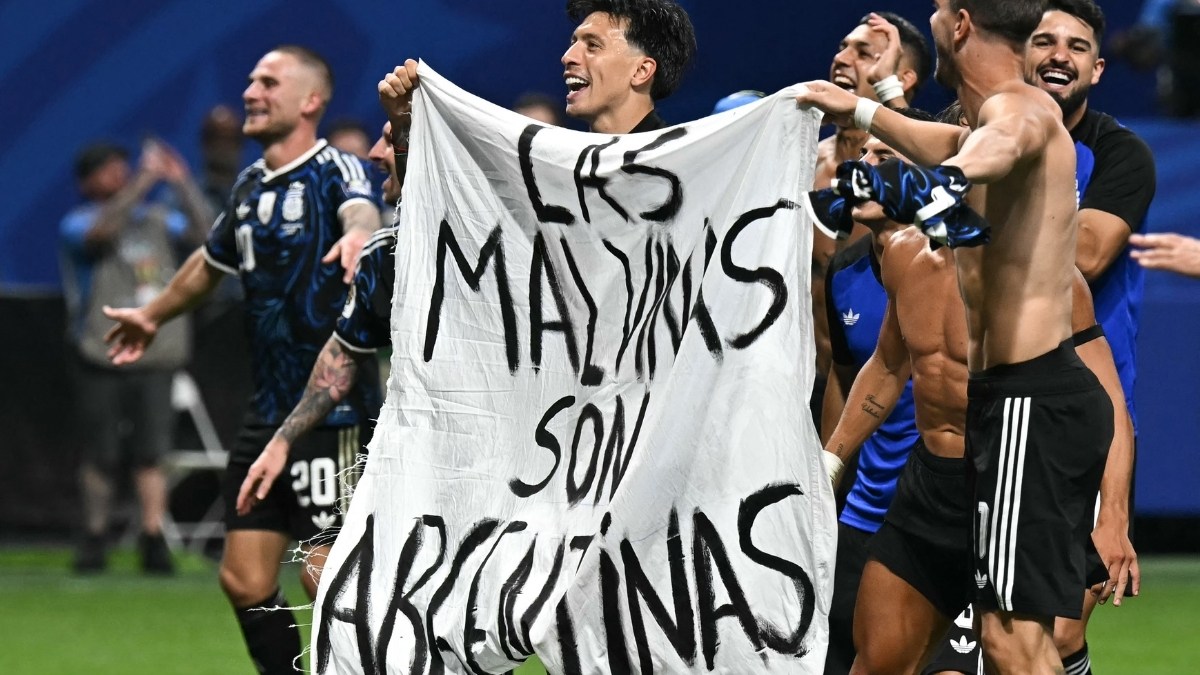
While celebrating the victory, Argentine midfielder Giovani Lo Celso and defender Nicolas Otamendi were seen holding up a large white banner that read “Las Malvinas son Argentinas,” which translates directly to “The Malvinas are Argentine”.
Lo Celso paraded the sign alongside teammate Cristian Romero before laying it flat on the grass. Reports indicate the banner was originally confiscated or gathered directly from the travelling Argentine supporters in the stands.
The Rules on Political Displays
Football’s governing bodies maintain an incredibly strict stance against bringing politics into the stadium. According to the International Football Association Board (IFAB) rulebook, player equipment and clothing must not feature any political, religious, or personal slogans, statements, or images. The rules state clearly that any breach will result in disciplinary action from the tournament organizers or FIFA.
Additionally, the display goes completely against FIFA’s stadium code of conduct. The official guidelines explicitly prohibit any promotional or fan materials including flags, fliers, banners, and clothes that carry a political or offensive message aimed at any country, group, or individual.
What is the Falkland Island Issue?
There is a history regarding the controversial ‘Las Malvinas’ which is the Argentine name for the Falkland Islands. These islands are a British dependency located roughly 300 miles (480 km) off the eastern coast of Argentina. The territorial dispute has caused heavy friction between Britain and Argentina since the early 19th century.
The political tension exploded into a short but bitter military conflict in 1982, when Argentina’s military government invaded the islands to seize control from the United Kingdom. The war lasted from April 2 to June 14, ending with an Argentine surrender. The brief conflict claimed the lives of 649 Argentine troops, 255 British personnel, and three civilians. Because of this historical baggage, matches between England and Argentina always carry immense emotional weight.
What Lies Ahead for Argentina?
FIFA’s standard procedure is to wait for the comprehensive match reports from the on-field referees and match commissioners before opening an official investigation. While there is no specific deadline for a final ruling, FIFA has previously taken a hard line on political symbols. Just last month, a court in Los Angeles upheld FIFA’s strict ban on pre-revolutionary Iranian flags at the tournament.
Even with the looming threat of a financial fine or warning from FIFA, the Argentine team must quickly refocus on their football. They are scheduled to face Spain in the World Cup final at the MetLife Stadium this coming Sunday. If they manage to win, Argentina will become only the third country in the history of football to win back-to-back World Cup titles.
Story first published: Thursday, July 16, 2026, 18:40 [IST]
Source link
#FIFA #Probe #Argentina #World #Cup #SemiFinal #Win #England #Falkland #Issue #Explained