
Long before it became the name on a football jersey, Samaleswari was the spiritual soul of western Odisha. Revered for centuries on the banks of the Mahanadi in Sambalpur, Goddess Samaleswari has remained the region’s presiding deity, worshipped by generations of devotees and once regarded as the Ista Devi of the Chauhan rulers.
Believed to safeguard the land and its people, the deity continues to occupy a central place in the cultural identity of Sambalpur, symbolising faith, resilience and community.
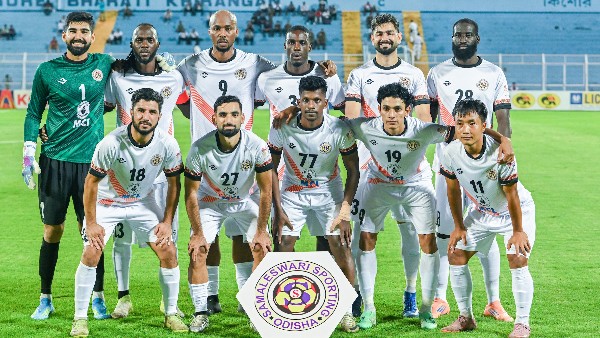
That legacy has now found a place in Indian football through Samaleswari Sporting Club, a club carrying the goddess’ name and the aspirations of an entire region. The side recently scripted history by making its debut in the 135th Indian Oil Durand Cup, India’s oldest football tournament.

Although the newcomers suffered a narrow 1-0 defeat to the Indian Army Football Team in Kolkata, their spirited display marked a significant milestone for a club that has risen from humble beginnings to compete on one of the country’s biggest football stages, bringing western Odisha into the national spotlight.
Durand Cup 2026: The Long Road Ahead
Samaleswari Sporting’s journey to the Durand Cup is a story of perseverance, community ambition and an unwavering commitment to football in western Odisha. Founded in March 2006 in Pitapali, a small settlement around 15 kilometres from Sambalpur, the club emerged far from the glamour and financial muscle associated with Indian football’s traditional powerhouses. Located in the shadow of the Hirakud Reservoir, the club was established with a simple vision: to provide a platform for local footballers and give the region a sporting identity that extended beyond its famed dam and Sambalpuri handloom tradition.
Recognising the need to nurture talent at the grassroots, the club established the Sambalpur Football Academy in November 2008. The initiative was driven by then Sambalpur MLA Jayanarayan Mishra, along with Gouri Shankar Sahani and former Odisha Chief Minister Rajendra Narayan Singh Deo. They aimed to create a structured pathway for young footballers from western Odisha, a region that had historically remained on the fringes of India’s football map. Mishra, who continues to own the club and serves as the academy’s managing trustee, has remained closely associated with its growth over the years.

The investment in youth development soon translated into success on the domestic circuit. Samaleswari Sporting became regular participants in prestigious competitions such as the Churachand Singh Trophy and AIFF knockout tournaments, while also reaching the finals of the Sambalpur Cup and the Biju Patnaik Memorial Trophy on several occasions. These performances earned the club recognition from the All India Football Federation (AIFF), paving the way for its entry into the I-League 2nd Division in 2012.
Competing against established clubs at the national level proved to be a steep learning curve. Samaleswari finished fifth in Group A during their debut campaign, falling short of qualification for the next stage. Their second season was even more difficult, yielding just one victory and leaving them near the bottom of the standings. Following those campaigns, the club gradually disappeared from the national football landscape, spending years rebuilding through Odisha’s state league system.
Rather than fading away, Samaleswari Sporting quietly rebuilt its foundations by continuing to invest in local talent and grassroots development. That patience eventually paid off with a historic nomination to the 135th IndianOil Durand Cup. From a modest village club in Pitapali to competing in India’s oldest football tournament, Samaleswari Sporting’s rise stands as a testament to resilience and the enduring belief that footballing dreams can flourish far from the country’s traditional centres of the game.
Dream Beyond Scoreboard
The impact of Samaleswari Sporting’s rise is perhaps best reflected in the journeys of its players. Goalkeeper Rahul Oram, who only took up football at the age of 15, embodies the opportunities the club has created for youngsters from western Odisha. Although he did not feature in the opening Durand Cup fixture against the Indian Army Football Team, being part of the squad itself was a milestone.

“Belonging from a place like Sambalpur, coming here to a big city like Kolkata is like a dream come true,” Oram said. “It is a great feeling that I have a chance to play in the Durand Cup against some of the teams whose names I have heard for so long. I know East Bengal FC and Mohun Bagan Super Giant are big clubs here.”
He also acknowledged the support of his family back home, saying they were proud of his achievement and hoped to make them even prouder. Oram’s journey mirrors that of Samaleswari Sporting itself, a club providing footballers from smaller towns the opportunity to dream beyond their surroundings and compete on one of India’s biggest stages.
Samaleswari FC’s Durand Cup Draw
Drawn in Group B alongside the Indian Army Football Team, Mohammedan SC and fellow newcomers Baghpat FC, Samaleswari Sporting entered one of the toughest groups in the competition.
Their first assignment came against the Indian Army at Kolkata’s Kishore Bharati Krirangan. The difference in experience was immediately evident as the Army side controlled possession and dictated the tempo for long periods. Samaleswari spent much of the evening defending, facing sustained pressure from opponents renowned for their physical conditioning and tactical discipline. Yet the Odisha club refused to collapse.
The breakthrough eventually arrived through a moment of quality rather than prolonged dominance, with P. Christopher Kamei curling home a second-half free kick. Even after falling behind, Samaleswari continued to compete, thanks largely to goalkeeper Aaryan Anjaneya, whose series of impressive saves prevented the margin from widening.
Although the match ended in a 1-0 defeat, the newcomers left the field having demonstrated resilience, organisation and belief against vastly more experienced opposition.
The result also served as an important learning experience. Every minute played against teams of such calibre offers valuable lessons for a squad still adapting to national-level competition.
The significance of this campaign cannot be measured solely by points or standings. From a football academy established near the Hirakud Reservoir to competing in Asia’s oldest football tournament, Samaleswari Sporting has rewritten what is possible for clubs from western Odisha. Their journey stands as proof that patient planning, grassroots investment and community support can overcome the limitations of geography.
For Sambalpur, the Durand Cup is no longer just a tournament watched from afar. It is now a competition in which one of its own proudly competes.
Source link
#Goddesss #Samaleswari #Sportings #Journey #Faith #Sambalpurs #Hinterlands #Durand #Cup #Glory