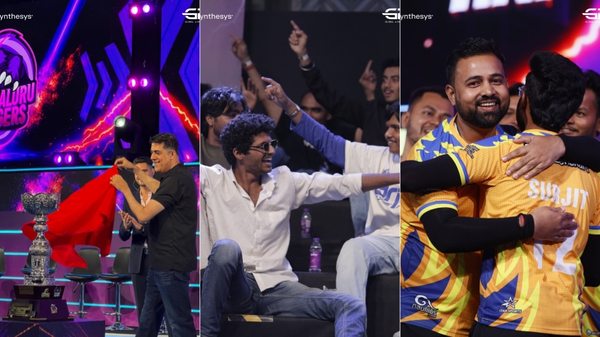

If you want to understand where Indian sport and entertainment spending is headed next, the answer lies in the country’s changing demographics. Gamers aged 15-24 accounted for more than 44% of India’s gaming spend in 2025, making them the single largest consumer cohort by a considerable margin. Mobile, meanwhile, dominates the ecosystem, accounting for around 62% of India’s esports activity. GEPL sits squarely at the centre of this shift.
The league is undoubtedly a Gen Z property, but that is more than just a demographic label-it’s the foundation of its business model.

That growth is reflected in GEPL’s registration numbers. The league expanded from 200,000 registered players in Season 1 to more than 910,000 in Season 2, highlighting its ability to attract an audience that mainstream broadcasters and brands have traditionally struggled to reach. These are young, mobile-first, digitally native consumers who are increasingly moving away from appointment television and engaging with sport on their own terms.
As the league grows, it is opening multiple revenue streams that extend far beyond competition itself.
Sponsorships and brand partnerships remain the biggest commercial driver, already accounting for nearly one-third of India’s total esports revenue, making them the largest revenue category in the sector.
Franchise ownership has also evolved into a long-term investment opportunity rather than a short-term marketing exercise. Season 2 franchise owners publicly committed to a three-year horizon, signalling confidence in GEPL’s long-term growth and treating team ownership as an emerging sports asset class.
Media rights represent another area of expansion. Season 3 marks GEPL’s first international broadcast agreement through Willow TV, bringing the league to audiences across the United States and Canada. The move not only taps into the Indian diaspora but also opens an entirely new advertising market beyond India.
The player economy is maturing alongside the league. During the Season 3 auction, franchises spent ₹62.75 lakh across 56 players, including a league-record bid of ₹3.50 lakh. Those figures reflect the emergence of a structured talent market, creating sustainable career pathways for esports athletes who previously had few opportunities to build professional careers.
The timing also aligns with the rapid expansion of India’s esports industry. The market is projected to grow from approximately $240 million in 2025 to well over $1 billion over the next decade. By combining cricket’s unmatched popularity with the economics of esports, GEPL is positioning itself to capture a significant share of that growth.
The Faces Behind GEPL Season 3: Cricket, Cinema, Capital, and Gaming Come Together
GEPL’s ownership group reflects the league’s ambition to bridge traditional sport, entertainment, business and gaming. Its franchise roster now includes personalities from cricket, Bollywood, venture capital, fintech and the creator economy.
The Mumbai Grizzlies are backed by investor and philanthropist Sara Tendulkar, whose involvement strengthens the league’s connection to cricket’s most recognisable family while reinforcing GEPL’s positioning as a natural extension of the sport’s mainstream audience.
The Pune Stallions are owned by actor and entrepreneur Suniel Shetty, one of the league’s strongest advocates. Shetty has described his investment as “a belief in the future of sport itself,” rather than a one-off commercial opportunity.
The Delhi Sharks are led by Peyush Bansal, founder and CEO of Lenskart, who brings extensive experience in building one of India’s most successful direct-to-consumer brands.
The Bengaluru Badgers boast one of the strongest business ownership groups in the league, featuring Nikhil Kamath, co-founder of Zerodha, Ankit Nagori, founder of Curefoods, and Prashant Prakash, partner at Accel India. Together, they bring expertise spanning fintech, entrepreneurship and venture capital.
Defending champions Chennai Falcons are owned by Gopal Srinivasan, Chairman of TVS Capital Funds, Madhusudanan R, co-founder of M2P Fintech, and Arjun Santhanakrishnan, Group CEO of GS Global. The trio has publicly committed to a three-year ownership horizon, underlining their long-term confidence in the league.
The Hyderabad Rhinos are backed by Amit Mehta, Director at LNB Group and a long-time investor in digital-first businesses. Mehta has spoken about GEPL’s role in amplifying young voices and creating genuine visibility for emerging esports athletes.
Season 3 also welcomes two new ownership groups.
The Kolkata Hawks are owned by legendary playback singer Sonu Nigam, who described GEPL as a natural extension of the way music and sport bring people together. His vision is to build a franchise that gives emerging talent a platform to be seen and heard.
Meanwhile, the Gujarat Wolves are owned by gaming icon Tanmay Singh (“Scout”), one of India’s most influential streamers and esports personalities. Born in Odisha and raised in Gujarat, Scout brings homegrown gaming credibility to the league while providing a direct connection to GEPL’s youngest and most digitally engaged audience.
Together, the ownership landscape reflects what GEPL is becoming-not just an esports competition, but a convergence of cricket, entertainment, technology, investment and creator culture that mirrors the future of Indian sport.
Source link
#GEPL #Business #Gen #ECricket #Building #Indias #Sports #Economy