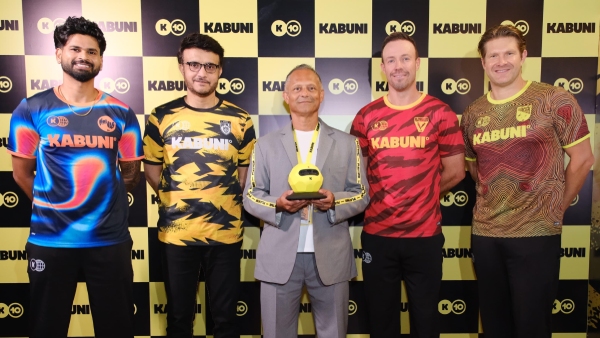

New Delhi: India has a vast pool of young sporting talent, but the absence of a structured system for children under 16 remains one of the biggest challenges facing the country’s grassroots sports ecosystem.
Nimesh Patel, founder and CEO of sports technology company Kabuni, believes that gap can be addressed by bringing together schools, technology, coaching and competition.

Patel, who relocated from the UK to India, initially came to the country with a different business proposition. But after speaking to schools and understanding the changing expectations of parents, he decided to build a broader sports ecosystem around his Play, Learn and Coach model.
Kabuni has already partnered with more than 50 schools and is targeting 400 schools as it expands across India. Its plans include the Kabuni Premier League, an Under-16 Kabuni World Cup, technology-led talent identification and 28 High Performance Centres inside schools.
In an exclusive interaction with myKhel, Patel spoke about Kabuni’s vision, India’s grassroots sporting challenges, the role of technology and AI, Khelo India Revamped Scheme, the importance of starting young and his ultimate ambition of seeing an Indian athlete win a major medal after beginning their journey through the Kabuni ecosystem. Here are the excerpts:
MyKhel: What convinced you that this was the right time to invest in transforming India’s school sports ecosystem?
Nimesh Patel: When I came to India in October last year, I came to sell a yellow ball with a subscription to help people learn sports better. But as I started exploring how to be successful in India – whether we go direct-to-consumer, sell to academies or go through schools – it became incredibly clear that India has 1.5 million schools, with half a million in the private sector.
The more school owners I met, the more I started to understand that we’re moving from an academic-first nation to parents requesting a more holistic education system beyond just academic excellence. Sports is one of the biggest topics.
You’ve got Khelo India, Fit India, now you’ve got the 2030 (CWG) Games and the 2036 Olympics. But the more I went into schools, the more I realised that we have a lot of schools with a lot of talent, but we have no sports system for under-16.
And therefore we’ve taken on the mantle of developing a programme around Play, Learn and Coach.
MyKhel: Could you elaborate on the Play, Learn and Coach model?
Nimesh Patel: Play is the Kabuni Premier League, which we piloted in May. Its ultimate goal is to be a pan-India sports league focused on multiple sports, but initially our focus has been cricket.
The plan is for 400 schools to participate annually across North, South, East and West. The winning team becomes the national winner for cricket. As we move into other sports, you’ll start to see the league develop other competitions.
Then we have the Kabuni World Cup, which will be hosted annually. Players will be selected by our Super Coaches, and 150 boys and girls from across India will play an Under-16 World Cup.
That’s an organic pathway to identifying talent under-16 and seeing where they can go in the future.
Learn is a curriculum. We have two pathways – one for athletes and one for sports teachers.
For sports teachers, we have a Level 4 certification covering coaching, sports science, sports psychology, strength and conditioning and other areas, so they have a more rounded view of how to nurture and develop an athlete.
Coach is our technology. We have a family of two devices. The round ball is a multi-sports device and the cricket stumps are specifically for cricket.
They can capture any player – bowler, batter or wicketkeeper – and give them a full post-match analysis.

MyKhel: How does the technology help identify and develop young talent?
Nimesh Patel: Our core technology tracks 35 biomechanical data points. It doesn’t differentiate between private and public schools if it can see the athlete. It can analyse and compare athletes across our platform to identify which athlete has a chance.
If we identify a talent through our in-school or after-school programme, that talent should be sent to our High Performance Centre to be taken to the next stage.
Technology has to be at the heart of this because there simply aren’t enough coaches to identify and nurture every talented athlete.
MyKhel: You have spoken about building 28 High Performance Centres. What is the plan?
Nimesh Patel: We’re going to launch 28 High Performance Centres inside schools – 14 in state schools and 14 in private schools. We will fund the development in three phases: Cricket Excellence, High Performance and Multi-Sports.
Think of them as Apple Stores inside schools. One thing India has an abundance of is sports facilities inside schools that have not been utilised to their best. Some schools have 30 or 40 acres of sports grounds, but no system to bring them together in a collective way to manage and nurture talent.
Whether it takes me five years or 10 years, we will have 28 centres across India that are exclusively inside schools.
MyKhel: Why focus on schools rather than building standalone facilities?
Nimesh Patel: Because I don’t have to buy land. I don’t have to pay rent. I don’t have to pay utilities. I just have to invest in the infrastructure and make it a joint venture with the school brand.
Eventually, it should be a joint venture with the government when I start looking at state schools.
MyKhel: How important are initiatives such as Khelo India and Fit India to this vision?
Nimesh Patel: Khelo India, Fit India and the 2036 and 2030 Games are huge moments. But I would go one step further. Unless there’s a private-public sector partnership, it’s never going to happen.
You need private-sector support and initiatives and companies. This cannot be built on just government and charity. And the second ingredient is that it has to be technology-first.
You can’t identify talent purely through traditional methods. There aren’t enough coaches of any category, not just in India, in any country, who can actually spot and nurture talent and find talent. So it’s got to be a technology-first approach.
MyKhel: How will you ensure that talent from state schools gets the same opportunities as talent from private schools?
Nimesh Patel: If I sit and wait for a state school or government to partner with me, I’m going to be sitting here three years before I do anything. But if I put one centre in a private school and demonstrate the data, it’s unarguable.
We’ve built the High Performance Centre, we have 25,000 children accessing it, and here are 15 athletes that are maturing. If we scale this across the state, here’s the outcome we’re looking at. That will accelerate discussions.
We all know that state schools have incredible talent that just never sees the light of day. But I have to pick a path to get me to that goal. Focusing on private schools, setting up the infrastructure and demonstrating the outcomes gives me an easier discussion at government and state level.
MyKhel: You have said technology can improve sports participation and athlete development by up to 50%. How do you measure that?
Nimesh Patel: Success is measured by improvements. You have to use our system to capture your play and then it advises you back on how to learn. We track the ball and biomechanics and then we’ve created a league infrastructure.
If you’re playing in one net and you’ve taken 10 balls and this is your run score and points, somebody in another country could be playing in another net and they could be competing.
We’ve taken traditional gaming theory, where we put kids into screens, and I want to reverse engineer that: put kids into cricket nets or sports fields and have them competing with their real bodies versus a joystick.
MyKhel: What has been the response from schools and parents so far?
Nimesh Patel: I haven’t had a great chance to speak to many parents, but the few that I have spoken to have been incredibly positive. I’ve done orientations for groups of 150 to 300 kids. The younger they are, the more excited they are about it. The older they get, there’s a little less enthusiasm in my view.
In terms of schools, the response has been overwhelming. I think in business we talk about timing, or entrepreneurs do. There is a material shift in parents’ requests from schools beyond academic excellence. Many, many schools are looking for a sports solution.
MyKhel: Why do you believe India needs to start identifying athletes much earlier?
Nimesh Patel: It’s accessibility. We have no infrastructure at that age. Honestly, if you did some research, all of our infrastructure in India is for above 16. All of it.
I’ve lived in Canada and England with my kids, so I’ve seen two school systems, private and state. The accessibility to quality coaching and infrastructure at a very young age is vastly different to this country. That’s the difference.
We can’t change that unless we focus on putting better infrastructure and better coaching systems in place for kids under 16. The child has to have a joy and obsession with the sport first. And joy and obsession comes with an experience.
That experience has to change for us to have any hope of improving the outcomes of this nation’s sporting ambition.
MyKhel: Is cricket’s dominance in India an obstacle to developing Olympic sports?
Nimesh Patel: Cricket in this country is a religion, not a sport. And I don’t think that will ever change. Every country has a sport-first nation – England is football, cricket here, American football in the US.
But we need to look at and take these other sports seriously at a much younger age. That means putting a new experience and system in place. The child has to try it to love it.
If you’re in a school that can’t try the 100-metre sprint or shot put, how do you know you’re going to love it?
MyKhel: Which sport will Kabuni take up after cricket?
Nimesh Patel: We don’t know yet, but it will be an Olympic sport for sure – which cricket is now in the Olympics, just so we’re clear!
Which school has the biggest adoption outside cricket is where we will channel our energy.
MyKhel: You have built and scaled businesses across different countries and sectors. How have those experiences shaped your approach to Kabuni?
Nimesh Patel: I’ve been successful, but I’ve had failures too. I’ve had two IPOs under my belt. My first IPO is the world’s number one software today in the legal sector, conveyancing. In 2008, I was also overleveraged and had to hand over 27.5% of that company to a white knight. But I’m still on the chessboard.
What I’ve learned in my last 20 years and what gives me hope and more joy is that I have absolute clarity to the end.
I know I’m going to see a young athlete pick up a trophy or a medal at a major sporting event and they will say that it started in a school and on the Kabuni platform.
That clarity gives you absolute discipline.
MyKhel: How receptive have schools been to the use of technology and AI in sports?
Nimesh Patel: Overwhelmingly yes. They all know, to some degree, that technology is the way forward to actually help this next generation learn a sport.
AI is going to be in everybody’s lives in one aspect or another. In five years’ time, everyone’s going to be using certain levels of AI in their lives, whether it’s healthcare, education, sports or entertainment.
Schools are very aware of it. They know this.
MyKhel: There are concerns around AI, data and privacy. How do you address those inhibitions?
Nimesh Patel: I think technology gives an added advantage. Shreyas Iyer said something that I thought was very relevant. He said that if he had been able to identify his flaws when he was young, it would have benefited him to another level.
Data is already a major part of professional sport. The difference is that we’re trying to give young athletes access to that kind of information much earlier. The objective is not simply to tell a child their weaknesses. It’s also about identifying their strengths and helping them replicate what they do well.
MyKhel: Tell us more about the Kabuni World Cup.
Nimesh Patel: The Kabuni Premier League is the school league. From the school league, we want to identify 150 kids in India to play a World Cup. Each team will represent one of our Super Coaches.
Think of the huge iconic sporting leagues in America and the way college sport works there. Just think of that at this level.
Every school can compete in the Kabuni Premier League, but the selection from the data will identify 150 kids to compete – boys and girls.
From that, you find stars. If you replicate that in other sports, you start to see a pathway programme.
MyKhel: Will there also be scholarships for young athletes?
Nimesh Patel: We’re launching our scholarship programme later this year. It will not be for private-school kids. It will be for state-school kids to get access to better coaching and other opportunities. We’re still working through the details, but there will be a pathway.
MyKhel: If we have this conversation five years from now, what achievement would make you feel Kabuni has truly transformed school sports in India?
Nimesh Patel: Somebody picking up a trophy or winning a medal at a major sporting event. That’s my job done. Because the day that happens, there’s 100 million kids on that platform chasing that pathway. In every meeting I have, every step I take in a school, I meet a school owner, a parent, a child – that’s all I can think about.
MyKhel: You have spoken about a resignation letter that sets out your long-term goal. What does that represent?
Nimesh Patel: I expect that resignation letter to be reality between 2030 and 2036. I will resign with no qualms that day, no regrets, but I’ve done my job. People need to know that you can lead, but if you lead without clarity on an end game, people don’t know what we’re aspiring to.
Everybody in my company knows, every partner knows, that that moment has to come sooner than later. I’m a realist too. It’s not going to happen overnight. But my discipline and focus on building the best sports experience for children under the age of 16 is never going to waver.
MyKhel: What is the focus of Kabuni’s upcoming webinar with Shane Watson?
Nimesh Patel: It will be around mental health and wellness. Shane Watson is a very big advocate for this. He believes that we have done hundreds of years of external coaching and training for athletes, and very little time has gone into understanding the mental strength of an athlete and what it takes to have confidence through adversity.
We lose many athletes through poor preparation of the mental part of the game. At a very young age, we lose a lot of athletes because the stress is difficult to manage and they don’t know how to deal with adversity. He is very deeply connected to that conversation.
MyKhel: Finally, what would success look like for Kabuni?
Nimesh Patel: Somebody winning a major medal after starting their journey through this system. That’s the clarity I have. If we can create a system where children discover sport early, enjoy it, receive better coaching, get identified through technology and have a pathway to elite competition, then we’ve done what we set out to do. That’s my job done.
Source link
#Nimesh #Patel #Reveals #Kabunis #Vision #TechnologyDriven #School #Sports #Ecosystem #India #Exclusive