
Patiala (Punjab), Sep 4: For Indian athletes heading to the Aichi-Nagoya Asian Games 2026, preparation is extending beyond training halls, competition venues and recovery routines. They are also being given a chance to experience, well before they reach Japan, what could be one of the most unusual aspects of the continental Games – their accommodation.
The 20th Asian Games, scheduled to be held in Aichi-Nagoya from September 19 to October 4, will bring together more than 11,000 athletes from 45 countries and regions, along with the OCA Refugee Team. Competitions will be held across 43 sports, comprising 71 disciplines and 469 medal events.

With the region facing accommodation constraints, organisers have opted for a decentralised accommodation model rather than a conventional single athletes’ village.
One of the most distinctive elements of the arrangement is a so-called floating village, with the luxury cruise ship Costa Serena docked at Nagoya Port and expected to accommodate around 4,600 athletes and officials. Another 2,400 participants are expected to stay in temporary modular accommodation at Garden Pier, while the remaining athletes and officials will be housed in hotels spread across Aichi and other regions, mapped according to competition venues.
For most Indian athletes, staying on a cruise ship or in hotels is unlikely to be a major adjustment. The temporary modular units, however, present a different challenge.
The organisers have converted shipping-container-style units measuring around 40×8 feet into accommodation for four athletes. For athletes accustomed to conventional rooms, the compact surroundings could require an adjustment – both physically and psychologically.
That is where the Sports Ministry has stepped in.
SAI creates a replica container at Patiala and Bengaluru
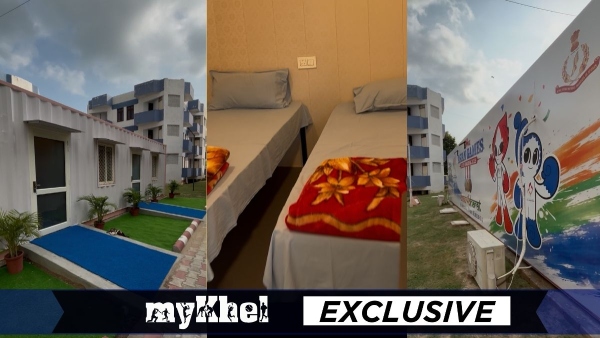
To ensure Indian athletes do not encounter the accommodation for the first time after arriving in Japan, The Sports Authority of India (SAI) has created replica units at NS NIS Patiala and SAI Bengaluru.
The objective is simple: let athletes experience the space beforehand, sleep inside the unit and understand how they can organise themselves in the compact surroundings.
At NS NIS Patiala, the replica has been converted into a complete living unit for four athletes. It includes four beds, four individual cupboards, air conditioning, a refrigerator, washing machine and electric kettle. There is also a small pantry area where athletes can cut or peel fruits and prepare food, along with toilet and shower facilities.
Vineet Kumar, Deputy Director General (DDG) SAI, while interacting with the medai said the initiative was not about merely recreating the physical structure but ensuring that athletes were mentally prepared before reaching Japan.
“Athletes should be mentally prepared from here itself that they will be staying in this type of accommodation, so they don’t face any setbacks or shocks upon arrival. Without any pressure, they can comfortably adapt to this accommodation so that their training isn’t affected.”
Kumar – who also serves as Excutive Director at NS NIS Patiala – underlined the importance of eliminating logistical distractions during a major competition. He added further, “An athlete’s psychology is so strong that if they face logistical issues, it affects their mental state and competition level. Keeping this in mind, it was the Hon’ble Sports Minister Dr Mansukh Mandaviya’s vision, which we have brought to life.”
The containers were already available
Interestingly, SAI did not have to procure new containers for the exercise. Kumar explained that the units were already available at the Patiala campus and had been used during the COVID-19 period.
“Fortunately, we already had both containers available here. During the COVID times, when movement was restricted, these were used to store weightlifting and athletics equipment. We didn’t need to buy new ones. We just moved the equipment to the store, vacated the containers, and converted them into this accommodation.”
The initiative was developed after a joint SAI-Ministry team conducted a recce of the arrangements for the Games.
“Absolutely,” Kumar said when asked whether the concept was inspired by the container accommodation seen during the their visit to Japan. “A joint team from SAI and the Ministry went there for a recce. This was all executed based on the report they submitted upon returning.”
Athletes spending nights inside the replica
The Patiala facility is not merely a demonstration model. Athletes from ongoing national camps are being given an opportunity to actually stay there.
Athletes already selected for the Asian Games are being allowed to stay in the unit on a rotational basis. “We have ongoing national camps here – boxing, weightlifting, some athletes, and fencing. We’ve created a roster for those already selected, allowing them to stay here turn-by-turn to acclimatise,” Kumar said.
The setup can accommodate four male athletes, while an identical unit has been created at the girls’ hostel for four female athletes. And the acclimatisation is deliberately designed around an overnight stay.
“It’s a night stay. They stay overnight so they understand how to wake up and function in the same conditions they will face there.”
The response, according to Kumar, has been overwhelmingly positive.
“No, nothing like that. In fact, the players enjoyed it. For them, it was like a miracle-like an oasis in the desert. They were amazed a container could be built like this. We tried our best to create a great ambiance so they wouldn’t feel claustrophobic.”
Shot putter Tajinderpal Singh Toor, who is chasing a record-extending third consecutive Asian Games gold, has already spent time inside the facility and shared his experience on social media.
“Players are sharing their feedback on social media. Shot putter Tajinderpal Singh Toor, who is going to the Asian Games, stayed here and his video is going viral. Everyone is very happy and amazed at how this was put together,” Kumar said.

But for India’s throwers, the challenge is more than psychological
While the compact accommodation could require an adjustment for all athletes, it could be particularly relevant for India’s throwers.
Discus, hammer and shot-put athletes typically have larger physiques and may require greater freedom of movement. A four-person room with four beds and limited open space could therefore feel considerably more restrictive.
That made the experience of Seema Kaliramna and Tajinderpal Singh Toor particularly relevant. Kaliramna, who won bronze at the 2026 Commonwealth Games in Glasgow, admitted that her first night inside the replica was difficult.
“I spent two nights here. Honestly, the first night was challenging as it felt claustrophobic. I couldn’t sleep whole night but on the second day my mind had adjusted to it.”
But she believes the experience could ultimately work in the athletes’ favour. “For us athletes, it’s important to keep all the distractions aside and focus on the task i.e. winning medals.”
Kaliramna also welcomed the opportunity to experience the accommodation before travelling to Japan. “It is a good initiative from SAI to give us athletes a peek at how things could be there and not get lost adjusting to such conditions and environment.”
For an athlete making her Asian Games debut, she believes the advance exposure could prove valuable. The Haryana athlete, who trains at NS NIS Patiala, added, “The experience of spending time here will definitely help me adjust to the conditions in Japan quickly and I will be able to focus on making my debut at the Asian Games memorable.”
Toor: ‘I was planning on taking some extra luggage’
Toor, meanwhile, brings the perspective of an athlete who has already experienced an Olympic Games village, having competed at the Tokyo and Paris Olympics.
The two-time defending Asian Games champion said the accommodation arrangement in Aichi-Nagoya would nevertheless be a new experience.
The 31-year-old athlete tells myKhel, “This is the first time the athletes are going to stay in makeshift accommodations in the Asian Games as we have been accustomed to staying at games villages. It will be a different experience not just for us, but for thousands of other competing athletes.”
At around 6 feet 3 inches, Toor is also among the athletes for whom space inside the compact units could be a consideration. Yet, rather than viewing the replica as a concern, he sees value in experiencing it beforehand.
“Yes, the size of this room is small but, I think, SAI here has done a good job to help us understand what it would actually feel like spending time there.”
The experience has even influenced how he plans to travel. “I was planning on taking some extra luggage but now I will cut down it a little.”
Toor will be joined in Japan by fellow Punjab shot-putter Karanvir Singh as he bids to become the first Indian athlete to win three consecutive Asian Games gold medals in the men’s shot put.
A temporary Asian Games solution with a permanent future
For SAI, the investment in the replica units is not intended to become redundant once the Asian Games conclude. Kumar said the Patiala facility will eventually be repurposed as a guest house.
“It’s a very unique concept; you won’t see this anywhere else. Once the Asian Games are over, we will use this as a guest house. We’ll remove two beds and make it a twin-sharing accommodation. It will be great for coaches who come here for camps.”
That gives the unusual experiment a second life beyond the Games.
India has approved a 768-member delegation, including 503 athletes – 269 men and 234 women – and support staff, for the Aichi-Nagoya Asian Games. The Indian contingent will compete across 36 sports disciplines.
For those athletes, the container at Patiala or Bengaluru may therefore be more than an unusual training-camp experience. It is effectively a dress rehearsal for life in Aichi-Nagoya.
Source link
#Asian #Games #India #Builds #Replica #Container #Homes #Prepare #Athletes #Unusual #AichiNagoya #Accommodation