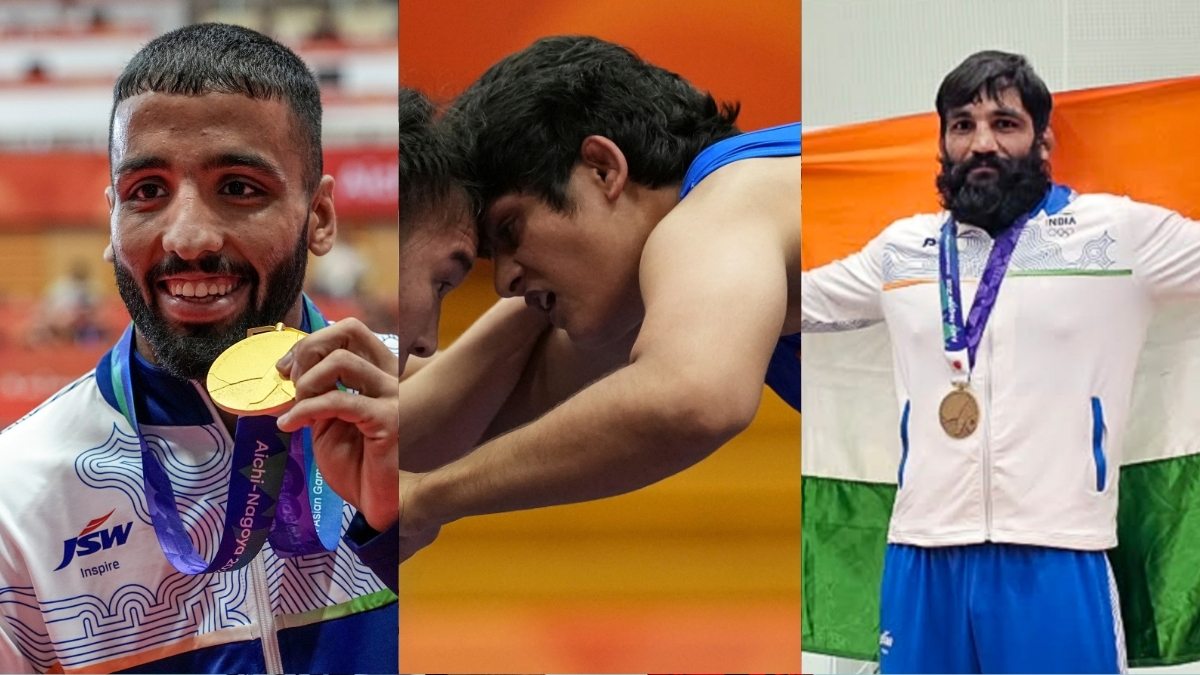

Six medals. Two golds, two silvers, two bronzes. For Indian wrestling at the Asian Games, that tally means something specific: the best century this program has had, and the second-best performance in its entire history.

The Best 21st-Century Result, Second Only to 1962
India’s six-medal haul in Aichi-Nagoya ranks behind only the 1962 Asian Games, where Indian wrestlers won 12 medals – three gold, six silver, three bronze. Every edition since then has fallen short of 2026’s total, which puts this result in genuinely rare company across more than six decades of Indian wrestling history.
| Edition | Gold | Silver | Bronze | Total |
|---|---|---|---|---|
| 1962 | 3 | 6 | 3 | 12 |
| 2026 | 2 | 2 | 2 | 6 |
| 1978 | 2 | 1 | 0 | 3 |
| 2018 | 2 | 0 | 1 | 3 |
| 2023 | 0 | 1 | 5 | 6 |
The two golds alone match India’s best gold-medal tallies from 1978 and 2018, and only the 1962 edition has ever produced more.
A Medal in Every Colour
Beyond the raw count, there’s a structural detail that makes this campaign stand out: India won at least one gold, one silver, and one bronze in the same edition. That specific combination – a medal in every colour – has only happened five times in Indian wrestling’s Asian Games history: 1962, 1970, 1982, 2014, and now 2026.
It’s a meaningfully different achievement from simply racking up medals in one category. Winning across gold, silver, and bronze in the same Games reflects depth spread across multiple weight categories and disciplines – Freestyle, Greco-Roman, and Women’s wrestling all contributed to this year’s tally – rather than success concentrated in one corner of the roster.
Three Separate Droughts, Each Decades Long, Broken in the Same Week
Perhaps the most striking thread running through this campaign is how many individual, long-standing gaps in India’s wrestling record were closed at this single event.
Aman Sehrawat delivered India’s first-ever Asian Games gold in 57kg Freestyle, beating North Korea’s Chong Song Han – the world No. 1 and reigning 2025 World Champion – 11-7 in the final. Ranked just 32nd himself, it was a result built almost entirely on upsetting the form book, and it upgraded his own bronze from the 2023 Games.
Nitesh became only the second Indian Greco-Roman wrestler ever to reach an Asian Games final, following Maruti Mane’s silver all the way back in 1962 – a 64-year gap between India’s first and second Greco-Roman finalists in the discipline. He got there by winning his semifinal 9-0 in under two minutes.
Deepak Punia, competing in a new 97kg weight category, delivered India’s first medal in that specific weight class since 1966 – a 60-year gap. He lost his semifinal 8-9 before recovering to win the bronze-medal bout 2-1, extending a podium run that already included silver at 86kg back in 2023.
What Else Stood Out
Sujeet Kalkal’s gold at 65kg Freestyle came on his Asian Games debut, and he did it without dropping a single match all season – his semifinal win over Japan’s Kiyooka Kotaro, the 2024 Olympic gold medallist, was settled 3-3 on criteria before he closed out the final 10-9. He became only the third Indian to win gold in that category, after Yogeshwar Dutt (2014) and Bajrang Punia (2018).
Antim Panghal, the women’s 53kg world No. 1, upgraded her own 2023 bronze to silver, reaching the final without conceding a point across two bouts. Sunil Kumar’s bronze at 87kg Greco-Roman made him the first Indian Greco-Roman wrestler with medals at consecutive Asian Games, following his own 2023 bronze.
Even outside the medal table, there were signs of genuine depth building: Sagar Jaglan returned from a season-long injury layoff to beat a reigning Olympic champion en route to a fifth-place finish, while debutants Mansi and Dipanshi each came within a single bout of reaching the podium themselves. Six debutants in total – Sujeet, Sagar, Dipanshi, Manisha, Rajat Ruhal, and Priya Malik – suggest this isn’t simply a peak built on experienced hands, but a genuine base being laid for the Olympic cycle ahead.
The Bigger Picture
Taken together, these three threads – a historic overall haul, a rare medal-in-every-colour campaign, and multiple individual droughts broken in the same week – paint a picture of a program that didn’t just have a good tournament. It closed gaps that had sat open for six decades, built medal depth across three distinct disciplines, and did much of it through wrestlers either new to the Asian Games stage or returning from genuine setbacks. For a sport where, as the numbers show, outcomes often turn on a single point or a judge’s criteria, that’s about as complete a showing as India has produced this century.
Story first published: Monday, October 5, 2026, 15:38 [IST]
Source link
#Asian #Games #Wrestling #Indias #Haul #Historically #Significant