
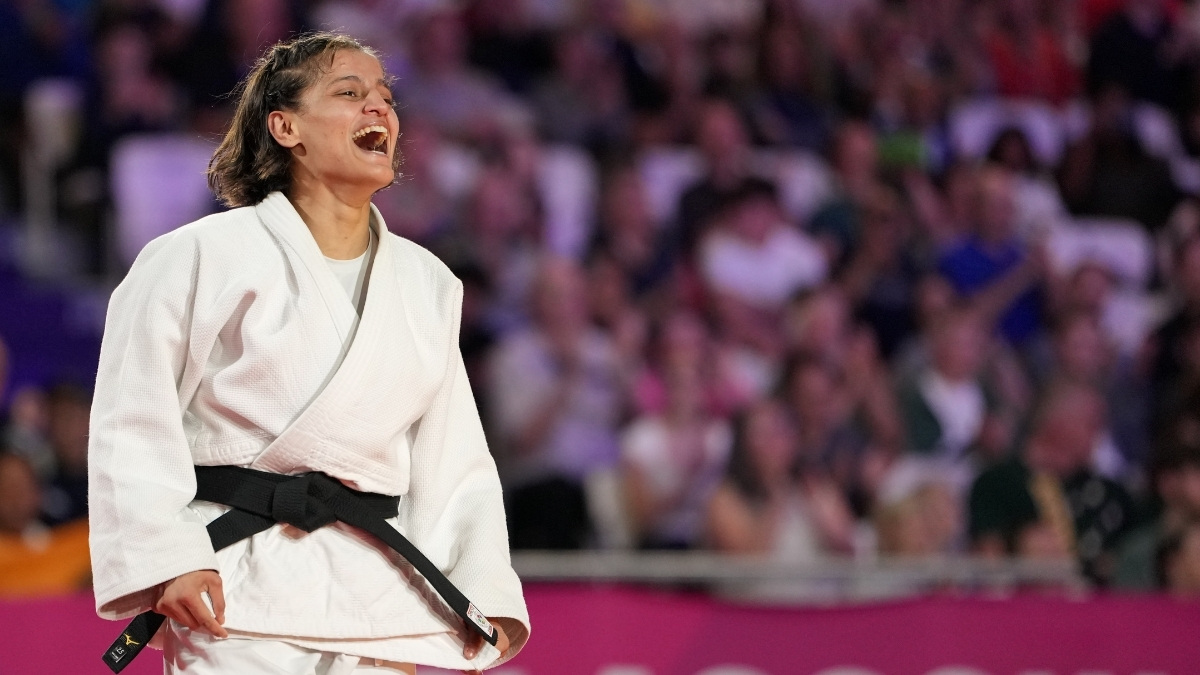

Asmita Dey scripted history for India at the Commonwealth Games 2026 after winning a stunning Gold in the Women’s 48kg division.
Coming from behind, the Tripura-born judoka struck the win via Golden Score to defeat Canada’s Heidi Quach in the final.

Asmita Dey has turned adversity into Historic Gold for India, but along her journey, she has mastered her game. Since the early days, hardwork and talent have propelled her to the summit, but in terms of the Judo technique, O-soto-gari and Tomoe-nage are her go to mode for attack, which she has mastered through the years.
MyKhel caught up Pranab Saha, a coach in Tripura who oversaw Asmita’s journey closely. Saha depicted the two terms, which have earned the 23-year-old many medals, and played a crucial part in the final as well.
“O-soto-gari and Tomoe-nage, Asmita has done magic with these two techniques. We have many modes in Judo, but Asmita’s ability to use these two is amazing. She has mastered legwork and often bamboozles opponent with that,” Saha said to MyKhel.
O-soto-gari (Major Outer Reap)
O-soto-gari is one of judo’s most fundamental and effective throws using the leg. The judoka first breaks the opponent’s balance by pulling them backward before stepping alongside them. Using a powerful sweeping motion, the attacker reaps the opponent’s outer leg while driving their upper body to the mat.
Tomoe-nage (Circle Throw)
Tomoe-nage is a spectacular sacrifice throw in which the judoka intentionally falls backward to generate momentum. Placing one foot on the opponent’s abdomen or hip, the attacker pulls with both hands while lifting with the leg, sending the opponent over their head in a circular arc.
How Asmita used these two Techniques to win CWG 2026 Gold
Asmita used Tomoe-nage in the regulation period to score and level the contest. She fell backwards and flipped her opponent, Heidi Quach to get her point. With the final extending into Golden Score, Asmita sealed victory with a perfectly executed O-soto-gari. The technique involves breaking the opponent’s balance backwards before sweeping (reaping) the outside of their leg while driving the upper body to the mat. It is one of judo’s most effective and high-percentage throws and secured India’s first-ever Commonwealth Games judo gold medal.
We want to be like Asmita Didi: Tripura
Asmita’s Commonwealth Gold goes beyond the short-term festivity, rather, it may have planted the seeds for the Judoka renaissance in Tripura, the state she belongs. Saha says the Indian athlete has already been an inspiration, and with her Gold, Judo has found a new face in the peripheral state.
“As a coach, as a citizen of Tripura, we are proud of Asmita. It is a huge turning point as well. The Tripura government has prioritized Judo among the games, and Asmita’s rise is a result of that. At our centres, the kids say ‘we want to be like Asmita didi’, which itself makes me proud. She is an icon, and we hope she will continue to make India and Tripura proud.”
Story first published: Saturday, August 1, 2026, 19:11 [IST]
Source link
#Asmita #Dey #mastered #OSotoGari #TomoiNage #Judo #Techniques #Win #CWG #Gold #Coach #Pranab #Saha #Explains #EXCLUSIVE