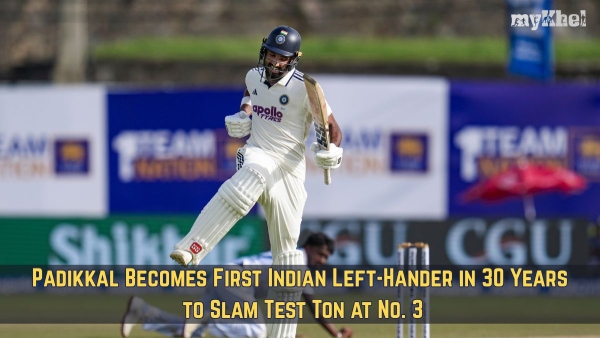
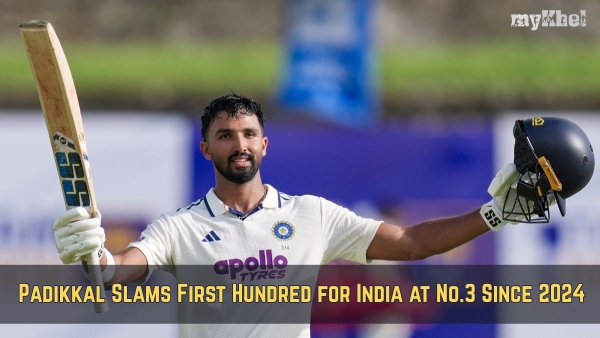

Galle, August 15: Devdutt Padikkal’s opportunity to make a case for India’s No. 3 position arrived because of an injury. By the end of the first day of the Galle Test on Saturday (August 15), he had given the Indian team management considerably more to think about than simply who should replace Sai Sudharsan.
Padikkal produced his maiden Test century, finishing the rain-hit opening day unbeaten on 131 off 178 balls, with 12 fours and a six, as India reached 288/2 against Sri Lanka. He brought up his hundred from 134 deliveries, becoming the first Indian to score a Test century at No. 3 since Shubman Gill’s hundred against Bangladesh in September 2024.

The innings was particularly valuable because it came in Galle, where Sri Lanka were expected to make their spin attack the centre of their strategy. The tall left-handed batter from Karnataka did not allow the conditions or the occasion to dictate his approach, building his innings steadily before taking greater control as the day progressed.
The 26-year-old’s maiden Test hundred also came after an unbeaten 142 in India’s practice match against the Sri Lanka Cricket XI, giving him centuries in successive appearances in Sri Lanka.
An opportunity created by injury
Padikkal entered the Test XI after Sai Sudharsan was ruled out, with the Karnataka batter getting the nod at No. 3. He had already made a strong case during the preparation period, particularly with his hundred in the practice game.
There was still a difference between scoring heavily in a tour match and doing it when the Test was underway, particularly after India lost Yashasvi Jaiswal to an unfortunate run-out. Jaiswal and KL Rahul had put together 47 before the dismissal, leaving Padikkal to walk in earlier than India would have wanted.
Rather than allowing Sri Lanka to regain control, Padikkal settled into a partnership with Rahul. The two put together 150 runs for the second wicket, with Rahul scoring 77 before retiring hurt after suffering cramps.
The partnership was important because it took the pressure away from India’s new No. 3. Padikkal was able to build his innings without having to manufacture scoring opportunities, while Sri Lanka’s bowlers struggled to maintain consistent pressure.
By tea, India were 197/1, with Padikkal unbeaten on 84 and Rahul on 77. Sri Lanka had managed to extract some turn, but India had largely prevented the spinners from settling into a prolonged spell of control.
Padikkal’s approach against spin stood out
The conditions in Galle made this an important examination of Padikkal’s technique. Sri Lanka had built their attack around the threat of Prabath Jayasuriya and Ramesh Mendis, two spinners with an imposing record at the venue. Padikkal’s response was not to retreat into defence. He regularly got forward to the ball, used his feet when the opportunity presented itself and was prepared to play the sweep and work the ball into the leg side.
That approach allowed him to keep the scoreboard moving even when Sri Lanka were able to extract turn.
His fellow statemate Rahul – who has been one of the most prolific run-scorers for India in the red-ball format lately – once again dropped the anchor and shared a big partnership for the second wicket before getting retired hurt (77*).
Padikkal and Rahul’s innings also had enough patience to withstand interruptions. Rain affected the day’s play but the duo waded through those conditions deftly.
After Rahul walked back into the dressing room, India subsequently lost their captain Shubman Gill for 16 to Jayasuriya. With the hosts eyeing an opportunity to make inroads Padikkal, however, remained composed and continued his innings alongside Rishabh Pant, denying the opposition any opportunity.
The final partnership between Padikkal and Pant took India to 288/2 from 73 overs before bad light ended play. Padikkal had faced 178 balls by then, while Pant was unbeaten on 27.
A two-year wait for an Indian No. 3 century ends
The statistical significance of Padikkal’s hundred is difficult to overlook. Before Galle, the last Indian to score a Test century from No. 3 was Gill, who made 119 against Bangladesh in Chennai in September 2024. Padikkal’s hundred therefore ended a wait of nearly two years for an Indian batter to reach three figures from the position.
No. 3 has historically been one of the most important batting positions for any Test playing side. Rahul Dravid and Cheteshwar Pujara occupied it for long periods for Team India, while Gill subsequently became one of the principal candidates to carry the role into the next generation before owning the number four spot in the post-Virat Kohli era.
Padikkal’s innings does not, by itself, settle India’s long-term selection question, and one Test innings cannot determine a player’s future. But the circumstances of this hundred make it difficult to ignore.
Padikkal was selected because an opening emerged. He had already scored heavily in the practice match. When India needed him at No. 3 in the Test, he produced a substantial innings against an attack operating in familiar home conditions.
The No. 3 question is now more interesting
India’s selection dilemma was straightforward before the Test: Sudharsan was unavailable, Padikkal had been in good form and Sarfaraz Khan – the replacement for Sudharsan – was another option. Padikkal’s performance has changed the nature of that discussion.
His domestic record had already provided evidence that he could handle red-ball cricket. He scored 543 runs at 60.33 for Karnataka in the 2025-26 Ranji Trophy season, including a double century. The unbeaten 142 in the practice game then provided another indication that he had adapted well to Sri Lankan conditions.
The 131 not out against Sri Lanka is the strongest evidence yet because it came in a Test, against an attack designed to exploit the conditions. He now has a maiden Test century, an overseas hundred and a No. 3 hundred in the same innings. More importantly, he has given India a potentially significant option in a position that had been waiting almost two years for its next century.
At the end of a disrupted first day in Galle, 131 not out can turn Padikkal’s selection from a stopgap decision into a genuine selection debate for India’s next Test.
Source link
#Devdutt #Padikkal #Galle #Masterclass #Indias #Ended #TwoYear #Drought