
Mirzapur has rarely been mentioned in the same breath as world athletics. The Uttar Pradesh district is better known for the stories of crime and lawlessness that have shaped its image than for producing international athletes. It has no major athletics stadium, limited facilities and, according to Ashish Yadav, very little support for young athletes.
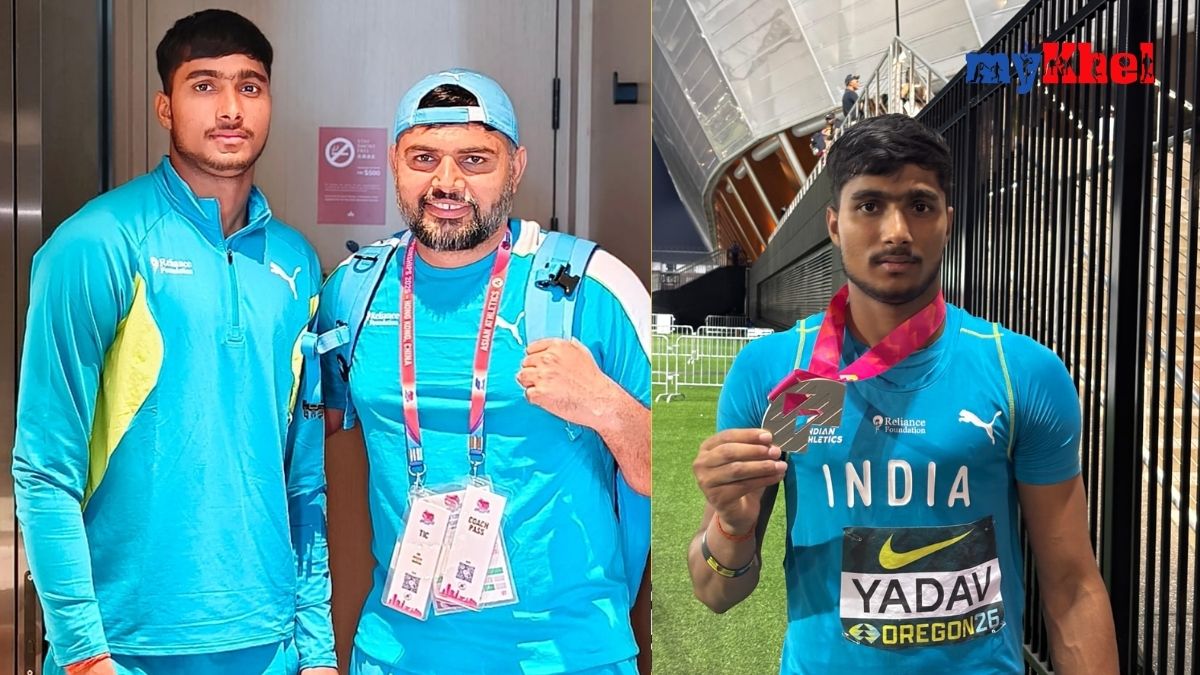
Yet, from this very place has emerged a young javelin thrower who has put India back on the world junior podium. Ashish Yadav won the silver medal in the men’s javelin throw at the World U20 Athletics Championships in the United States on Saturday, August 8, producing a best throw of 74.09m.

The medal came just after the symbolic day for Indian athletics. August 7 is celebrated as National Javelin Day to mark Neeraj Chopra’s historic gold medal at the Tokyo Olympics in 2021. Five years after that unforgettable moment, Indian javelin has another young name to celebrate.
And the timing could hardly be better. Ten years after Chopra won gold at the 2016 World U20 Championships, Ashish has brought India another medal in the same event.
Neeraj started it. Ashish has now carried the story forward. The South African Jan-Hendrik Heymans won gold with a huge 80.50m throw, but Ashish stood tall among the world’s best young throwers. His series read 69.96m, foul, 74.09m, 72.31m, 70.62m and 67.98m.
The silver was not simply another medal for India. It was a reminder that the country’s javelin story cannot and should not end with one superstar.
Ashish entered the championship with a personal best of 74.49m and had already shown enough quality to be considered a medal contender. He topped his qualification group and eventually delivered when it mattered most.
His season, however, had not been perfect. He won silver at the Junior Federation Cup with a throw of 73.12m, finished fifth at the Asian U20 Championships with 69.58m and came third at the Indian Athletics Series-9 in Ludhiana with 72.27m.
There were doubts. There were setbacks. There was even pain in his ankle before the World U20 final. But Ashish did not allow any of them to define his championship.
“I feel very good. Neeraj Sir had uploaded a video on social media, and I watched it. In the video, he said that we should not hesitate when it comes to our performance. He told us to keep working hard and focus on what lies ahead. He also said not to focus too much on supplements and not to do unnecessary things. His message motivated me.”
That is perhaps the most important part of Ashish’s story. The medal did not come because everything went perfectly. It came because he managed to compete despite the things that did not go his way.
Ashish’s first two attempts in the final were far from what he wanted. His opening throw was 69.96m before he fouled his second attempt.
There was also an ankle problem. For a young athlete competing on one of the biggest stages of his career, it would have been easy to panic.
Instead, he tried to keep his mind away from the medal table. “I had a little pain in my ankle, so I was a little scared. Because of that, I couldn’t perform well initially. I thought I would throw 79m, but I couldn’t do it.”
He admits that the morning of the competition was not easy either.
“I slept at around 12 in the night and woke up at 7 in the morning. After that, I was a little scared and kept thinking, ‘Will I perform well or not?’ I was not thinking about winning a medal. I just wanted to give my best.”
That mindset eventually produced his best throw of 74.09m. Sometimes, in elite sport, the breakthrough comes when an athlete stops chasing the result and concentrates on the next attempt.
The most powerful part of Ashish’s story is not his medal. It is where he started.
He began throwing the javelin in Mirzapur, where proper training facilities were hard to find. At one point, he was training with a wooden javelin.
His first coach in his hometown was Ashish Singh Rathore. Later, in April 2025, his life changed when he moved to Jaipur to train under Arvind Kumar. The improvement was remarkable.
“My coach, Arvind Kumar Sir, is very good. He is like God to us. He helped me reach this level. He trusted me a lot.”
When Ashish first joined Arvind Kumar, he was throwing around 60m. Within months, he had made a significant jump.
“When I started with him, I was throwing around 60m. In six months, he helped me improve significantly. I joined him in April 2025.”
His coach’s belief in him came at a time when Ashish was not even the biggest thrower in the group.
“I used to be one of the athletes who threw the least on the ground. I was throwing around 60m when I participated in the trial conducted by our coach. I finished fifth in that trial.”
From fifth in a trial to second in the world. That is the distance Ashish has travelled in little more than a year.
Ashish’s sporting journey also has a strong family connection. He comes from a family that understands the demands of athletics. His uncle, Dharmaraj, is a discus thrower, while his aunt, Poonam, is an Olympian and a medallist at the Commonwealth Games and Asian Championships. She has also competed at the World Championships multiple times.
But talent alone cannot build an athlete. Opportunity matters.And that is where Ashish’s story becomes a larger question for Indian sport.
Ashish speaks honestly about the place where he grew up.
“The place I come from is known for criminal activities. Parents in my village do not always focus enough on the schooling and education of their children. But my parents made sure that I did not fall into the wrong company.”
His parents protected his dream. His coaches developed it. But the system around him did not always help.
“In Mirzapur, there is no proper stadium, no facilities and hardly any infrastructure for athletics.”
He competed extensively while living there and won medals at the state and national levels. Yet, he says, there was little recognition or support from the district.
“I won many medals at the state and national levels, but we did not receive any support from the Mirzapur district.” He adds.
“No one from the district contacted us or asked about our performances. There is very little support for athletes in Mirzapur.”
These words should not be treated merely as a complaint from a young athlete. They should be treated as a question.
How many Ashish Yadavs are still waiting in India’s smaller towns because nobody has found them?
How many talented athletes are training without proper equipment? How many are competing without access to good coaches? How many dreams disappear because a child from a small town never gets the opportunity to move to a better training centre?
India cannot build a sporting nation only through medals won by athletes who somehow manage to escape these limitations.
Ashish’s fifth-place finish at the Asian U20 Championships could have become a setback. Instead, it became part of his learning process. He believes conditions played a role in that performance.
“There was a small problem. I had done some good throws during the warm-up, but the weather conditions were not good. The food was also not good, and I was not getting proper food. I was even eating watermelon.”
The conditions in the United States suited him better. His training at JSW in Bellary had also helped him prepare for similar weather.
“The weather here was good for me. I had been training at JSW in Bellary, and the weather conditions there were similar to what we had here, so I was comfortable.”
The lesson is simple: young athletes need the right environment as much as they need talent. It is tempting, whenever a young Indian javelin thrower wins a major medal, to immediately call him the “next Neeraj Chopra”.
But Ashish does not need that label. Neeraj’s achievement is already written into Indian sporting history. Ashish now has the opportunity to write his own.
His silver medal is only the beginning.
He is currently among the leading U20 javelin throwers in the world and has already shown that he can respond to disappointment, pressure and difficult circumstances. His 74.49m personal best at the start of the season, followed by a World U20 silver, shows the potential ahead.
The real challenge now is not to rush him. It is to protect his development.
Give him the right coaching. Give him proper facilities. Manage his workload. Look after his nutrition and recovery. Allow him time to mature as an athlete.
And most importantly, do not let the pressure of comparison with Neeraj Chopra become bigger than Ashish Yadav’s own journey. Ashish’s silver medal belongs to him, his family and his coaches.
But it also belongs to Mirzapur. A boy who once threw a wooden javelin in a place without proper athletics infrastructure has now thrown his way onto a world championship podium.
That is what sport can do. It can change the way a town sees itself. It can give children a different dream. It can show that a lack of facilities at birth does not have to become a lack of ambition for life.
But for that to happen, the medal must lead to action. If Ashish’s success is celebrated only on social media for a few days, Indian sport will have missed the bigger story.
The bigger story is the boy from Mirzapur who had talent before he had facilities. The bigger story is the coach who believed in a 60m thrower.
The bigger story is the family that kept him away from the wrong path. And the bigger story is a sporting system that now has a responsibility to make sure the next Ashish does not have to begin with a wooden javelin.
Five years after Neeraj Chopra’s Olympic triumph, Indian javelin has another reason to dream. Ashish Yadav has brought home silver. Now India must help him build the road to gold.
Source link
#Mirzapur #World #Podium #Ashish #Yadavs #Silver #Medal