
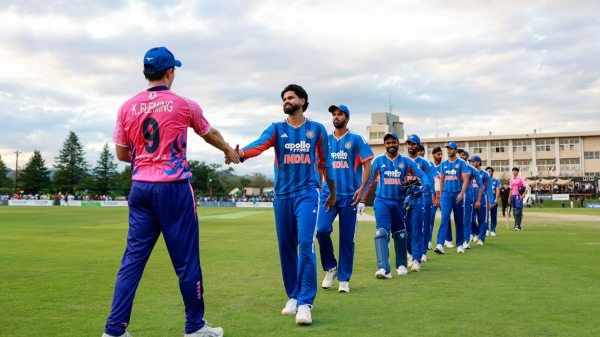

Rain nearly stole the show before a ball was even bowled in Sano. What followed instead was one of the more remarkable near-upsets in recent cricket history – a reigning T20 World Champion side reduced to 32/4 by a team with no professional cricketers, before somehow escaping with a two-run win.

The historic one-off T20I between India and Japan, marking 75 years of diplomatic relations between the two nations, was in serious doubt for much of the morning. Persistent damp patches delayed multiple ground inspections, with officials pushing the toss back repeatedly as conditions swung between sunny spells and returning cloud cover. By the time play was finally confirmed, the match had been reduced from its original format to a five-overs-a-side contest.
Shreyas Iyer won the toss and chose to bat, framing the occasion in broader terms at the toss: “It’s a big occasion, and we know the friendship, 75 years of friendship. So it’s going to be an exciting one, and we wanted to explore the conditions as well… It’s important that this match happened, and it’s happening today.”
Japan’s captain Kendel Kadowaki-Fleming admitted he’d have preferred to bowl first, purely to give the home crowd a longer look at India’s stars: “We probably would have bowled, just to give the crowd an opportunity to see some of the best players in the world go at it here. But yeah, I was happy either way.”
India’s Batting Collapses Against Japan’s Spin
What followed stunned everyone inside Sano International Cricket Ground. India lost Abhishek Sharma for a golden duck in the very first over, top-edging a Charlie Hara-Hinze delivery straight to short fine leg. Sanju Samson followed soon after for 9, undone by sharp turn off Ibrahim Takahashi and caught at deep midwicket. Ishan Kishan lasted only three balls longer, miscuing a flighted delivery from Benjamin Ito-Davis straight up for an easy catch – leaving India reeling at 14/3 inside three overs.
Shreyas Iyer and Tilak Varma did what they could to salvage respectability, rotating strike through the fourth over, but Iyer eventually fell for 16 off 12 – the top score of the innings – caught by Ibrahim Takahashi off Hara-Hinze, who finished with figures of 2/17. India limped to 32/4 from their five overs, a genuinely startling total against a side with no history at this level.
Japan’s Chase Puts India Under Real Pressure
Chasing just 33, Japan lost opener Lachlan Yamamoto-Lake early, run out for 1 by a sharp piece of fielding from Ishan Kishan after a mix-up between the wickets left him well short of his ground. Ibrahim Takahashi followed for 4 shortly after, caught at deep square leg off Washington Sundar, leaving Japan at 7/2.
But Kadowaki-Fleming and Benjamin Ito-Davis refused to let the game slip. A costly over from Ravi Bishnoi – ten runs conceded – brought Japan right back into contention, leaving them needing just 15 off the final two overs. Washington Sundar struck again to remove Kadowaki-Fleming for 12, caught off a leading edge, reducing Japan to 25/3 and needing 8 off the final over.
A Final Over Decided by the Finest of Margins
Axar Patel was handed the job of closing it out, and the over turned into a genuine thriller – two contentious wide calls went Japan’s way, trimming the target ball by ball as Shirai-Patmore and Ito-Davis found singles wherever they could. With four needed off the final delivery, Shirai-Patmore swung hard for the win but could only get an inside edge that rolled away for a single. India held on to win by two runs, sealing the historic contest on the very last ball.
Final Scores
- India: 32/4 (5 overs)
- Japan: 30/3 (5 overs)
- India won by 2 runs
Washington Sundar finished as the standout bowler for India with figures of 2/13, doing the bulk of the defensive work once Japan’s chase gathered momentum. Charlie Hara-Hinze was the pick of Japan’s attack with 2/17, including the wicket of Abhishek Sharma inside the first over.
What This Result Actually Says
For India, the outcome will raise real questions rather than settle them. Bowled out inside five overs by spin on a slow, turning surface, with only Iyer reaching double figures, this is a batting performance that offers little reassurance heading into their Asian Games campaign on similarly unfamiliar conditions. Iyer himself acknowledged as much before the match, noting the value of “knowing the conditions” ahead of the tournament proper.
For Japan, though, there’s little to be disappointed about. They restricted the reigning world champions to 32, took the chase to the final ball, and gave the home crowd – and the wider cricketing world – a genuine glimpse of what this program is building toward. As Kadowaki-Fleming put it before a ball was bowled, hoping simply that “the more people that watch cricket in Japan, the better” – on the evidence of this match, Tuesday in Sano did more for that cause than years of quiet development ever could.
Story first published: Tuesday, September 22, 2026, 14:30 [IST]
Source link
#India #Japan #T20I #World #Champions #Survive #Runs