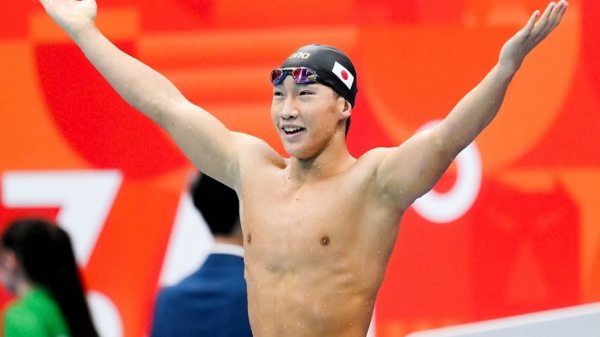

At just 17, Shin Ohashi has gone from being one of Japan’s most promising young swimmers to a world-record holder.
Ohashi announced himself on the biggest stage at the 2026 Asian Games on Thursday, winning gold in the men’s 200m breaststroke in 2:04.83 and breaking the world record previously held by China’s Qin Haiyang.

The Japanese teenager shaved 0.65 seconds off Qin’s mark of 2:05.48, set at the 2023 World Championships in Fukuoka, to underline why he is increasingly being regarded as one of the most exciting young swimmers in the world.
But Ohashi’s rise has been anything but conventional.
Who is Shin Ohashi?
Shin Ohashi is a 17-year-old Japanese breaststroke specialist and one of the country’s emerging swimming stars.
Born in Japan, Ohashi took up swimming when he was just three years old after his family wanted him to be comfortable in the water around his grandmother’s backyard pond.
He currently stands at just 1.69m – under 5ft 7in – making him relatively short compared with many elite swimmers.
That has not stopped him from becoming one of the fastest breaststrokers on the planet.
Ohashi’s breakthrough came in 2026, when he began rewriting Japanese records and establishing himself among the world’s leading swimmers in the 100m and 200m breaststroke.
How did Shin Ohashi become a world-record holder?
Before Thursday’s Asian Games final, Ohashi already held the fastest 200m breaststroke time in the world in 2026.
His previous best of 2:06.59 was also a junior world record.
He had been closing in on Qin’s senior world record throughout the year, coming within roughly a second of the mark at the Japanese national championships.
At the Asian Games, however, Ohashi finally made the breakthrough.
His 2:04.83 not only secured gold in front of a home crowd but made him the first swimmer to break Qin’s 200m breaststroke world record.
Kazakhstan’s Denis Petrashov finished second in 2:08.67, while South Korea’s Cho Sung-jae took bronze in 2:08.76.
Shin Ohashi has already broken Kosuke Kitajima’s records
Ohashi’s rise has also seen him surpass one of the biggest names in Japanese swimming.
Earlier this year, he broke Japan’s national record in the men’s 100m breaststroke with a time of 58.67 seconds.
The record had previously belonged to Kosuke Kitajima, the Japanese great who won four Olympic gold medals and three world titles.
Ohashi’s performance at the national championships also made him Japan’s youngest-ever breaststroke triple-crown winner at 17.
For a country that has produced legendary breaststrokers such as Kitajima and Ippei Watanabe, Ohashi’s emergence represents a significant development.
What makes Shin Ohashi different?
Ohashi does not fit the conventional physical profile of an elite breaststroker.
At 1.69m, he is considerably smaller than many of the swimmers he competes against. Instead, he has developed his own approach by studying different elements of the world’s best swimmers.
He has described this as “hybrid swimming”.
Ohashi takes elements from several elite swimmers: Léon Marchand’s kicking, Adam Peaty’s upper-body work and Watanabe’s overall fluidity.
The result is a technique that has helped him compensate for his lack of physical size with efficiency and speed.
His versatility is also evident in training. Despite specialising in breaststroke, Ohashi reportedly swims more freestyle during practice because he can cover more distance that way.
The teenager who loves junk food
Away from the pool, Ohashi’s personality is rather less regimented than his swimming.
The teenager has openly admitted to having a weakness for crisps and fizzy drinks.
“I sometimes eat too much of that stuff before lunch and end up not properly eating lunch,” Ohashi said, according to Olympic Channel.
“I know I shouldn’t, but I can’t stop.”
It is an unusual detail for an athlete already operating at the highest level, but it offers an insight into the teenager behind the world record.
Even Léon Marchand is watching
Ohashi’s rapid progression has caught the attention of Olympic champion Léon Marchand, one of the leading figures in modern swimming.
Marchand, the Olympic 200m breaststroke champion, praised the Japanese teenager before the Asian Games and acknowledged the threat he represents.
“I’m scared. I’m very scared of him,” Marchand said.
The Frenchman also pointed to Ohashi’s age and the quality of the team around him as reasons for his potential.
That endorsement came before Ohashi delivered his world-record performance in Nagoya.
What comes next for Shin Ohashi?
The Asian Games world record is unlikely to be the final milestone of Ohashi’s career.
The teenager has already spoken about wanting to improve his time further and has previously targeted a 2:03 finish in the 200m breaststroke.
His immediate ambition is to carry his form into the 2027 World Championships, where he will face the world’s leading breaststrokers on an even bigger stage.
Beyond that lies the 2028 Los Angeles Olympics.
Ohashi will be only 19 by the time LA28 arrives.
For now, though, Japan has a new swimming star – and after Thursday’s 2:04.83, the rest of the world knows his name.
Source link
#Shin #Ohashi #Japans #17YearOld #World #Record #Holder