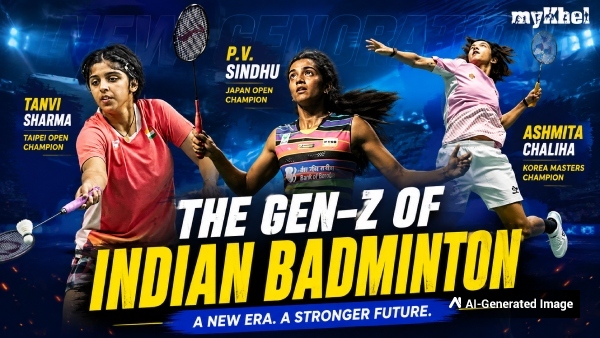

For nearly a decade and a half, the Indian women’s badminton has revolved around two towering names – first Saina Nehwal, and then PV Sindhu. That era is not over yet.
As Sindhu continues to prove that she still has plenty left in the tank, a new generation of Indian women shuttlers is beginning to make its own statement.

The most fascinating part of Indian badminton in 2026, therefore, is not simply Sindhu’s resurgence. It is the emergence of a young group of players who are winning titles and building reputations of their own while one of India’s greatest badminton stars continues to compete at the highest level.
Sindhu’s resurgence
After a difficult 2025 season affected by injuries, the two-time Olympic medallist from Hyderabad began 2026 outside the world’s top 15. But the 31-year-old produced one of the most significant results of her recent career at the Japan Open 2026.
Seeded 12th, Sindhu defeated three-time world champion Akane Yamaguchi 21-17, 21-17 in the final in Tokyo to win her maiden Japan Open title and her first Super 750 crown.
The victory ended a long title drought and made Sindhu the first Indian to win the prestigious Japan Open. It was also her biggest tournament triumph since her 2019 World Championships gold.
More importantly, it was a reminder that Sindhu’s story is far from finished.
At 31, the two-time Olympic medallist showed that experience, fitness and the attacking game that made her one of the most recognisable names in world badminton can still make her a formidable force.
While Sindhu was turning back the clock in Tokyo, another story was quietly gathering momentum.
The real story may be the generation behind her
The emergence of India’s young women’s singles players has been one of the most encouraging developments of the year.
Tanvi Sharma, Ashmita Chaliha, Devika Sihag and Unnati Hooda represent a group of players who are beginning to demonstrate that Indian women’s badminton can have considerable depth beyond its biggest superstar.
They are not being asked to become the “next Sindhu”. They are beginning to build something of their own.
Tanvi Sharma: 17 and fearless
At just 17, Tanvi Sharma has already demonstrated the temperament required to compete on the international stage.
Tanvi began her early training at the Gopichand Badminton Academy in Hyderabad before moving to the National Centre of Excellence (NCOE) in Guwahati, where she has trained under South Korean coach Park Tae-sang.
Park is no stranger to Indian badminton’s biggest successes. He was part of Sindhu’s coaching team during her bronze-medal campaign at the Tokyo Olympics and her gold-medal-winning run at the 2022 Commonwealth Games.
Under his guidance, Tanvi has developed an aggressive, attacking style. That approach came to the fore at the Taipei Open, where she defeated Vietnam’s Nguyen Thuy Linh in straight games to claim her maiden BWF World Tour title.
The triumph was particularly significant because it made Tanvi the first Indian woman to win the Taipei Open since Saina Nehwal’s 2008 triumph.
Her celebration after the victory was equally memorable. Tanvi took the gold medal from around her neck and placed it around Park Tae-sang’s neck – an emotional gesture that quickly resonated with badminton fans on social media.
For a teenager at the beginning of her international career, it was a moment that captured both her achievement and the role played by the coaching system behind her.
Ashmita, Devika and Unnati add to the depth
Tanvi’s breakthrough was followed by another landmark Indian women’s singles victory.
Ashmita Chaliha won her maiden BWF World Tour title at the Korea Masters, defeating China’s Han Qianxi 14-21, 21-14, 21-14 in the final. She became the first Indian to win the Korea Masters women’s singles title.
The victory was particularly impressive because Chaliha had to fight back after losing the opening game.
For Park Tae-sang, who has worked with both Tanvi and Ashmita, the two victories represented a hugely satisfying period for the Indian women’s singles programme. And the pipeline does not end there.
Devika Sihag and Unnati Hooda have also continued to make progress on the international circuit, with both youngsters already adding international titles to their resumes.
None of them yet possesses Sindhu’s Olympic pedigree or global stature. But that is precisely the point.
India may no longer need one player to carry the entire weight of its women’s singles ambitions.
From Hoshiarpur and Guwahati to Haryana: Talent beyond the traditional hubs
Perhaps the most encouraging aspect of this emerging generation is where these players come from. Tanvi hails from Hoshiarpur in Punjab.
Ashmita is from Guwahati, and her Korea Masters triumph was a landmark moment not only for her but also for Assam and the wider Northeast.
Devika Sihag and Unnati Hooda come from Haryana, with their journeys rooted in Panchkula and the Rohtak region respectively.
The common thread is important: none of them emerged from the traditional badminton ecosystem in the way India’s biggest stars once did.
They travelled to established training centres and elite academies to develop their games.
That is evidence of a much wider talent pool.
Indian badminton is increasingly finding players beyond a handful of metropolitan centres, and the emergence of the Guwahati NCOE is an important part of that transformation.
The system behind the surge
This generation has not appeared by accident.
The National Centre of Excellence in Guwahati was established with the larger objective of creating a stronger talent pipeline and ensuring that Indian badminton’s success did not depend on one or two exceptional athletes.
The coaching system, including Park Tae-sang, is now working with younger players from the formative stages of their careers.
That is a significant difference.
Park has previously drawn a distinction between working with an established champion and developing a young prospect. With someone like Sindhu, the task was largely about managing and refining an already world-class athlete.
With players such as Tanvi and the other emerging youngsters, the process is different.
They are being developed from the ground up.
And the early returns are encouraging.
One generation, not one successor
Sindhu’s influence has certainly not diminished.
Her Japan Open triumph was proof of that.
She remains one of the most decorated athletes in Indian sport, and her continued success gives the country’s young players an extraordinary benchmark to chase.
But the nature of Indian women’s badminton is changing.
Behind Sindhu is now a group of young players who are not simply waiting for their turn.
They are already winning.
Tanvi’s Taipei Open title and Ashmita’s Korea Masters triumph have provided the most visible evidence yet. Devika and Unnati add further depth to a group that could become increasingly important over the next Olympic cycle.
The question, therefore, is no longer simply: **”Who comes after Sindhu?”**
There may not be one answer.
The answer could be an entire generation.
India’s next era in women’s badminton may not be defined by the search for another PV Sindhu.
It may be defined by the arrival of several players capable of writing their own histories.
The Gen-Z generation has arrived – and it appears to have arrived earlier than expected.
Source link
#Sindhu #Indias #GenZ #Women #Shuttlers #Signal #Era #Badminton