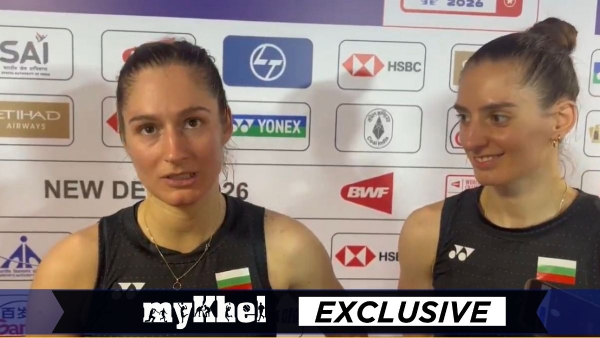

New Delhi, August 18: Gabriela and Stefani Stoeva have built one of European badminton’s most successful women’s doubles partnerships, collecting five European Championship titles, two European Games gold medals and representing Bulgaria at three consecutive Olympic Games: Rio 2016, Tokyo 2020 and Paris 2024.
Gabriela, the elder sister, and Stefani, a year younger, hail from Haskovo, Bulgaria, and have spent more than a decade competing together at the highest level. Their success has made them one of the most recognisable doubles pairs in European badminton.

But their journey has also unfolded against the backdrop of a country where badminton continues to struggle for mainstream visibility. In an interaction with the media at the ongoing BWF World Championships 2026 in New Delhi, the sisters spoke about the challenges badminton faces back home, the influence of their football playing father and how they found their way into the sport almost by accident.
The Bulgarian pair defeated India’s Simran Singhi and Kavipriya Selvam in the Round of 32. Having faced them twice previously, the Stoeva sisters knew what to expect but were also aware that their opponents had improved significantly.
“We know them pretty well. We’ve met them two times and we knew that it would be a very tough battle because from the last match which we played against them, they improved a lot,” Gabriela said.
“So they made it hard for us as well. Of course, we tried to keep up and not make easy mistakes, and I think this helped us today for the win. We were focused, followed the tactic and just enjoyed being on court,” she added.
Badminton still struggles for visibility in Bulgaria
For a pair with their experience, staying disciplined and sticking to the game plan has become particularly important. Their success has been built over years of playing together, but the sisters know that opponents continue to improve and challenge them.
Their own progress has also been closely linked to the development, or lack thereof, of badminton in Bulgaria.
“In our country it’s tough, especially for our sport, because in Bulgaria people cannot watch it on TV,” Stefani said.
“They can watch tennis, football, gymnastics and other sports, but ours is never on Bulgarian TV. So it’s hard even to get sponsorship because nobody knows our sport.”
The lack of television exposure creates a difficult cycle for athletes. Without regular visibility, it becomes harder to attract sponsors, while without sponsorship, it becomes harder to build the infrastructure and support needed to develop the sport.
“We try with our results to make it a little bit popular, but it’s tough when you cannot watch it on the national channels and when people don’t know where to look to watch our matches,” Stefani said.
The sisters have also tried to bridge that gap through their own social media platforms.
“We try through our social accounts and Facebook page to help people so they can watch our matches, but it’s tough,” Gabriela said.
There has, however, been a positive change since the Stoeva sisters established themselves as European champions.
“It’s changed, yeah. We can see in the clubs in Bulgaria so many kids start to play badminton,” Gabriela said.
“But still it’s tough when they cannot watch it on television.”
Their success has clearly helped inspire younger players, even if badminton has yet to reach the mainstream popularity enjoyed by football, tennis or gymnastics.
India shows them what a badminton culture can look like
The sisters said their experience in India had given them an opportunity to see what a stronger badminton culture could look like.
“We try to make it popular and I hope someday, like I said yesterday, to see how it is in India because we are very happy to see so many people here supporting them,” Stefani said.
“The Indian badminton is like a little family who is supporting each other and we are very happy to see Saikanov in Bulgaria.”
Family support remains strong despite the distance
The support they receive from home, meanwhile, remains strong despite the geographical distance.
Asked whether it was difficult knowing that their family would not be able to watch them live in India, the sisters said their parents have never allowed distance or inconvenient timings to become a problem.
“Our family wakes up even in the middle of the night to watch our matches, so it’s no problem,” Stefani said.
“Our father can find us everywhere. They put us on TV so we are not worried about it.”
What they would like, however, is for their family to experience a major badminton tournament in Asia in person.
“It’s sad that they cannot come here to see how it is in Asia to support us,” Gabriela said.
“I hope someday they can come to one tournament here in India or somewhere else just to see how it is in real life because our father is very stressed when he watches our matches.”
A football-playing father shaped their sporting journey
The family’s sporting connection actually predates badminton. Their father was a footballer in his younger years and played as a goalkeeper, although he never pursued the sport at a major club.
“It was our father who used to be a football player but never connected to badminton,” Stefani said.
They grew up in Haskovo, a small town in Bulgaria, at a time when access to the internet and social media was nowhere near what it is today.
“We are coming from a very small town in Bulgaria and at this time the internet was not so popular. People didn’t use computers and social media so much, and the only thing which we could do was play badminton with our family,” the sisters said.
Their father’s sporting background nevertheless influenced the way he approached his daughters’ sporting careers.
“I think in his young years he was a football player and a goalkeeper. I think because of that maybe he was pushing us so much and was hard on us in sports,” Stefani said.
“I think it’s helping us a lot because he was very strict on us and didn’t allow us to go in the wrong direction. So I think this was helping us a lot in our young years.”
The sisters then joked about how much control their father has over their sporting lives today.
“But now he cannot do anything,” Gabriela said with a smile.
Their badminton journey began almost by accident
Their entry into badminton was also far from a carefully planned sporting pathway.
It began with a friend who was already playing the sport.
“One of our friends used to play badminton. She started first,” Gabriela recalled.
Then one of their coaches happened to meet the family while picking up their friend from the badminton hall.
“One of the coaches there was going with my mum to pick her from the hall and asked me when I’m going to the badminton hall,” Stefani recalled.
The response at the time was emphatic.
“I said I will never step in the badminton hall anymore.”
More than two decades later, the irony is obvious.
“And look where I am 23 years later,” Gabriela said, before adding with a laugh: “So never say never.”
Their father’s footballing background still occasionally finds its way into family life, although not necessarily in the way one might expect.
The sisters recalled playing football with their father and sometimes dividing the family into opposing teams.
“Our father came to play badminton and then we go to play football with him,” Stefani said.
“Sometimes we do a family battle, my father and my sister against me and my mum.”
The obvious question was who usually wins.
“It depends who is fighting more,” Stefani replied, triggering another burst of laughter among the media.
That light hearted exchange perhaps best captures the story of the Stoeva sisters. Their journey has taken them from a small Bulgarian town where badminton struggled for attention to European titles, Olympic appearances and the biggest stages in world badminton.
Yet their motivation remains rooted in family, competition and a desire to make the sport more visible in Bulgaria.
For Gabriela and Stefani, their success is not only about adding another title to an already impressive résumé. It is also about ensuring that the children now walking into Bulgarian badminton clubs can see a pathway that the sisters themselves could barely imagine when they first entered the sport.
Source link
#BWF #World #Championships #Stoeva #Sisters #Bulgarias #Badminton #Struggle #Family #Roots #Journey #Top