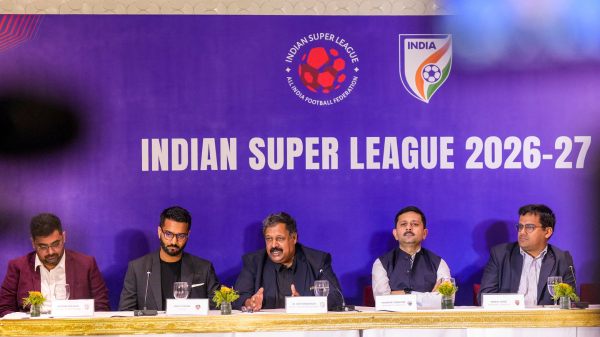

The Indian Super League (ISL) is set to operate under a new club-led model after the All India Football Federation (AIFF) handed over the league’s commercial rights to its 14 participating clubs ahead of the 2026-27 season.
The agreement marks one of the biggest structural changes in Indian football, with clubs taking charge of the league’s commercial operations for the next four years, while the AIFF will continue to oversee its administration.

What has changed in the ISL?
Under the new arrangement, the 14 ISL clubs will collectively own and manage the league’s commercial rights, including areas such as broadcasting, sponsorships and revenue generation.
The AIFF, meanwhile, will continue to handle the administrative side of running the competition.
“We are giving the clubs the commercial rights for this league. The AIFF shall hold on to the administrative aspects of organising the league,” AIFF deputy secretary general M. Satyanarayan said.
He also confirmed that clubs will receive formal invitations over the next 24 hours and have two weeks to confirm their participation for the 2026-27 season.
Why is this significant?
The move comes after a turbulent period for Indian football.
The 2025-26 ISL season faced months of uncertainty following the expiry of the Master Rights Agreement (MRA) between the AIFF and Football Sports Development Limited (FSDL), along with an extended legal dispute that delayed the competition.
The league eventually took place in a shortened format between February and May.
The 2026-27 campaign, however, is expected to return to its traditional home-and-away format, with organisers targeting a September 4 start date.
Financial sustainability becomes the priority
Club executives acknowledged that the new model places greater responsibility on the participating teams, particularly when it comes to making the league financially viable.
NorthEast United CEO Mandar Tamhane described the club-led structure as a model already followed by several established leagues around the world.
“It is uncharted territory for all of us. Hopefully, it will be beneficial for everybody involved,” he said.
FC Goa CEO Ravi Puskur added that financial sustainability would be the biggest focus under the new system.
“The entire process has to be driven by that. It has to be run based on how much money the clubs can recover,” Puskur said.
He also revealed that appointing a broadcaster is the immediate priority, with the clubs planning to issue a Request for Proposal (RFP) as soon as possible.
Can ISL clubs leave the agreement?
Although the agreement runs for four years, clubs have been given the option to exit the framework after two years if they choose.
However, Satyanarayan expressed confidence that the arrangement would remain intact.
“The way the clubs have come forward and shown confidence, I don’t see that happening,” he said.
The new structure signals a major shift in the governance of Indian football, placing clubs at the centre of the ISL’s commercial future while they look to build a more financially sustainable league.
Story first published: Wednesday, July 8, 2026, 23:00 [IST]
Source link
#Explained #AIFF #Handed #ISL #Commercial #Rights #Clubs