
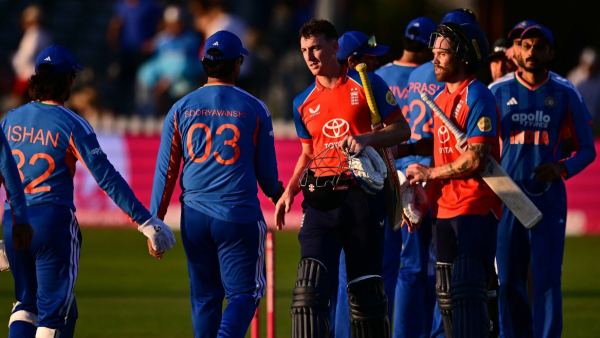

IND vs ENG: A humiliating nine-wicket defeat for Team India against England in the fourth T20I at Bristol on Thursday (July 9), will go down as one of the all-time lows in their history.
India’s first-ever bilateral T20I series defeat against England has exposed several cracks in the reigning world champions’ approach. The back-to-back bilateral T20I series defeat, after the 2-0 drubbing against Ireland, will be remembered for the Men In Blues’ lack of fight.

From contentious selection calls and questionable tactics to ineffective bowling and poor fielding, the Gautam Gambhir-coached side has plenty to ponder after suffering back-to-back series defeats, their first ever since 2019.
India arrived in England as the reigning back-to-back T20 World Cup champions under a new captain Shreyas Iyer. They will leave with their reputation bruised, several questions unanswered and a second successive T20I series defeat.
Harry Brook’s England mauled India at Bristol to take an unassailable lead in the five-match series and condemn India to their first-ever bilateral T20I series defeat against the hosts.
The manner of the defeat made the outcome even more damaging. After restricting India to a below-par total 158/7, England completed the chase in just 13.5 overs – their fastest successful chase of a 150-plus target in T20Is. Their previous best came in 14.3 overs against Pakistan in 2022, followed by 14.5 overs against West Indies in 2024.
For India, the defeat cannot be dismissed as an isolated failure. Coming immediately after their first-ever T20I series loss against lower-ranked Ireland, the England debacle points towards deeper problems with selection, preparation, tactics and adaptability.
Bold Selection Calls Backfire on Gautam Gambhir and India
The series began with two young captains, Shreyas and Brook, leading their respective teams. India, champions in 2024 and 2026, took the bold call of moving on from World Cup-winning captain Suryakumar Yadav and picking up some fresh faces with the aim to prepare a team for the future.
Several selection decisions were contentious even before the series began. With the results now going against India, head coach Gautam Gambhir and the team management will inevitably face questions over the personnel chosen for the tour and the playing combinations.
The handling of Sanju Samson is perhaps the biggest example. Samson, one of the senior members of the squad and player of the tournament in T20 World Cup 2026, was dropped from the playing XI after a failing to deliver in Ireland and the opening T20I against the English. In hindsight, that decision increasingly looks like a tactical blunder.
15-year-old batting sensation Vaibhav Sooryavanshi is an exceptional young talent with an enormously promising future, but the teenager struggled to make an impact in the three matches he played. Throwing a young batter into challenging English conditions while leaving out an experienced campaigner like Samson was always a gamble. It did not pay off.
The presence of a calmer and more experienced batter could have helped a line-up that repeatedly struggled to respond when its ultra-aggressive approach failed.

India’s All-Out Attack Approach Exposed
Under Gambhir and former skipper Suryakumar, India’s commitment to aggressive T20 cricket had delivered rich dividends. On batting-friendly surfaces and in familiar conditions, the philosophy helped transform India into the most dominant side in the format.
England, however, exposed the limitations of an approach that appeared to have no alternative.
Abhishek Sharma, Ishan Kishan and Sooryavanshi repeatedly looked to dominate the powerplay but struggled to assess the conditions and England’s bowling plans. The Indian batters appeared committed to slam-bang cricket irrespective of the match situation.
The problem was not aggression itself. It was the inability to recognise when aggression needed to be tempered with application.
English grounds presented different dimensions and conditions from those in the subcontinent, while the hosts constantly adjusted their lengths, pace and fields. India’s batters, in contrast, rarely demonstrated that they had done enough homework to counter those challenges.
Short Ball and Express Pace Leave India Searching for Answers
England’s fast bowlers identified another area to exploit – Indians’ struggles against high pace and short-pitched bowling. Their premier fast bowler Jofra Archer and the rest of the pace attack repeatedly tested the Indian batters with speed, bounce and hard lengths. India rarely found a convincing response.
The humiliation at Trent Bridge, where the visitors were dismissed for 76 in just 11.4 overs, was the most dramatic example. Five wickets fell inside the powerplay for the first time in India’s T20I history as the batters continued to attack despite the innings rapidly falling apart.
Senior spinner Adil Rashid has always been a challenge to the Indian batters but the visitors’ plan to counter-attack Will Jacks too backfired.
India had already been warned during the defeat against Ireland, but there was little evidence that lessons had been learned. Similar flaws resurfaced against a stronger and more tactically astute England side.
Shreyas Iyer Shows What India Were Missing
Amid the batting failures, captain Shreyas’ knock in the fourth T20I at Bristol stood apart from the rest, once again creating the impression that he and his teammates were batting on entirely different surfaces.
Shreyas – who is the leading run-scorer in the series with 190 runs in 4 games – gave himself time, assessed the bowling and trusted his ability to accelerate later. His approach was a sharp contrast to the one-dimensional batting displayed by several of his teammates.
His unbeaten knock of 80 in the fourth T20I also reinforced the biggest question surrounding India’s batting philosophy: What happens when Plan A fails? India never found a convincing answer throughout the series.
India’s Bowling Attack Equally Disappointing
The batters cannot shoulder the entire blame. India’s bowling attack was also a major disappointment. Neither the pacers nor the spinners consistently assessed the surfaces and conditions as effectively as their English counterparts.
While England’s fast bowlers relied on pace, bounce and hard lengths, the Indian seamers frequently resorted to changes of pace and slower deliveries. The tactic produced little reward. The difference in execution was stark.
England’s bowlers appeared to have clear plans for individual batters. India’s attack often looked as though it was searching for solutions during the game.
The number of no-balls only compounded the problem. Giving free hits and additional deliveries to aggressive England batters was an invitation to attack, and the hosts repeatedly capitalised.
Shreyas Iyer’s Captaincy Also Under Scrutiny
Shreyas’ batting may have been one of the few positives, but his captaincy will also come under the scanner. His bowling changes were difficult to understand at times. Bowlers who picked up wickets or appeared to be building pressure were not always allowed to continue, while the constant rotation of the attack prevented India from sustaining momentum.
The selection of the all-rounders – both spin and pace-bowling options – also deserves scrutiny.
A captain can only work with the resources provided to him, but Shreyas frequently appeared short of answers as England took control of matches.
Poor Fielding Completes India’s List of Problems
India’s fielding added another layer to an already disappointing campaign. Against a team as aggressive as England, missed opportunities and lapses in the field can quickly prove costly. India failed to consistently maintain the standards expected of world champions.
When combined with ineffective bowling, repeated no-balls and questionable tactics, the fielding errors made India’s task considerably harder.
The difference between the two teams was ultimately not just skill. England were better prepared, more adaptable and more disciplined.
A Wake-Up Call for World Champions
Losing a bilateral series does not suddenly make India a poor T20I side. They remain two-time reigning world champions and possess perhaps the deepest pool of talent in international cricket. But back-to-back series defeats cannot be ignored either.
The loss to Ireland should have provided a warning. The defeat in England has amplified it.
India’s selection calls did not work. Their batters struggled to adapt to unfamiliar conditions. The bowling attack failed to execute effective plans. The captaincy lacked clarity at crucial moments, while the fielding and discipline fell below expectations.
Most concerningly, India appeared to lack a Plan B. The aggressive philosophy that transformed them into world champions remains valuable, but no successful approach can remain rigid. Conditions change, opponents adapt and the best teams find different ways to win.
England did precisely that. India did not.
Source link
#Gautam #Gambhir #Shreyas #Iyer #Face #Tough #Questions #Indias #Historic #T20I #Series #Defeat #England #Exposes #Major #Flaws