
The year was 2006. The Indian cricket team was touring Pakistan, and I was covering the series for NDTV. It was in the press box at Lahore that I met a man whose gentle smile and unassuming presence concealed an extraordinary cricketing journey.
That man was Qamar Ahmed.

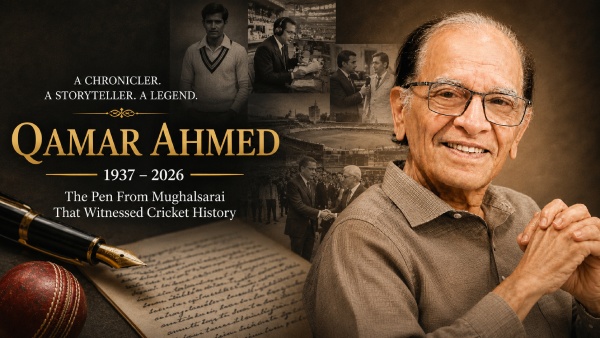
Today, June 18, 2026, Qamar Ahmed passed away following a heart attack. He was 88.
With his passing, cricket loses not merely a journalist but one of its most treasured chroniclers, a man who spent more than six decades documenting the game’s greatest moments and personalities.
Born in Mughalsarai, Uttar Pradesh, in 1937, Qamar Ahmed migrated to Pakistan after Partition. Before journalism became his calling, he played first-class cricket for Sindh and Hyderabad as a left-arm spinner. Among his proudest achievements on the field was dismissing three legendary brothers of Pakistan cricket: Hanif Mohammed, Mushtaq Mohammed and Sadiq Mohammed.
Yet it was through his writing that he left his deepest mark.
Qamar Ahmed began his journalism career as a freelance reporter in 1963. Over the decades, his byline appeared in some of the world’s most respected media organisations, including Reuters and AFP. His reporting earned admiration across continents for its accuracy, balance and deep understanding of the game.
In January 2014, while covering the Pakistan-Sri Lanka Test in Sharjah, he achieved a remarkable milestone by reporting on his 400th Test match. He became only the third journalist in cricket history to reach that figure, after John Woodcock and Richie Benaud. By then, he had also covered more than 730 One-Day Internationals and eight Cricket World Cups.
Numbers, however, tell only part of his story.
During that 2006 tour, I had several opportunities to interact with him. Those conversations remain vivid in my memory even today. What struck me most was his perspective. At a time when India-Pakistan cricket often became entangled in politics and emotion, Qamar Sahab viewed the game through a refreshingly clear lens. For him, cricket was always bigger than the noise surrounding it.
He carried within him an endless reservoir of stories.
Listening to him was like opening a living archive of cricket history. He spoke about advising Imran Khan in 1982 during the leadership transition that eventually made him Pakistan captain. He recalled visiting Sir Don Bradman at his Adelaide home and treasured a signed photograph from that meeting as one of his most cherished possessions.
What made those stories special was not merely their historical significance. It was the warmth, humility and authenticity with which he narrated them.
Despite spending a lifetime in journalism, he never lost his curiosity about the game. His observations remained sharp, his enthusiasm undiminished, and his love for cricket as pure as ever.
Qamar Sahab may no longer be among us, but his work, wisdom and memories will continue to inspire generations of cricket writers and followers. The 400-plus Test matches he witnessed, the countless stories he told, and the standards he set for cricket journalism ensure that his legacy will endure.
Today, cricket journalism bids farewell to one of its finest ambassadors.
A golden chapter has come to an end.
Inna lillahi wa inna ilayhi raji’un.
Qamar Sahab, thank you for the stories, the wisdom, and the history.
Story first published: Thursday, June 18, 2026, 18:46 [IST]
Source link
#Covered #Tests #Met #Bradman #Advised #Imran #Khan #Remembering #Qamar #Ahmed #Crickets #Gentle #Historian #Mughalsarai