
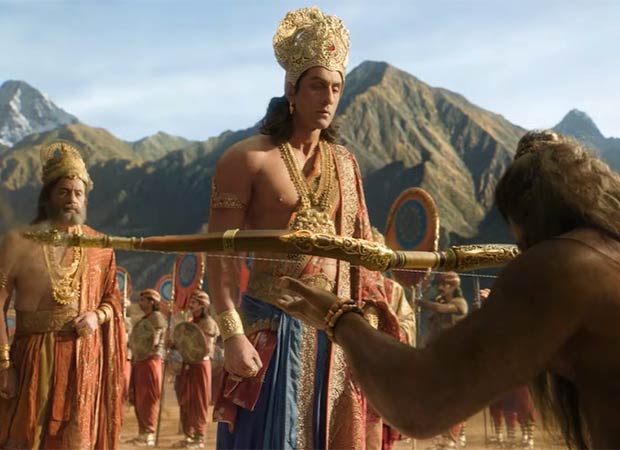
The English trailer of Nitesh Tiwari’s Ramayana: Part 1 has been released by Sony Pictures for audiences worldwide, offering an international preview of the upcoming epic. While the scale and visual effects have drawn attention, one of the key talking points has been the technology used to ensure that the actors’ lip movements match the English dialogue.
Ramayana English trailer: Namit Malhotra DECODES DNEG’s AI-powered lip-sync technology!
Unlike conventional dubbed versions, where a new voice track is placed over the original footage, the English version of Ramayana: Part 1 uses DNEG’s AI-powered technology to digitally adjust the actors’ mouth movements. Producer Namit Malhotra has now explained how the process combines human performances with technology to achieve a more natural result.
Namit Malhotra explains how Ramayana’s English lip-sync was created
Speaking to ET Now, Malhotra stressed that the process did not begin with AI. According to the producer, the first step involved human voice performances, with members of the principal cast also contributing their own English voices.
“If you’ve seen that, where we’ve got tremendous praise, where we’ve actually brought in human actors, voice actors, who actually come in and performed the voice performances. Some of them actually are done by the actors themselves, who have a good command over the language and are able to emote appropriately in a different language,” he said.
Malhotra explained that this human-led approach was important to preserve the emotional quality of the performances. “So we’ve done that as a first step to make sure that the rendering of that expression and emotion is authentic, and it’s led by humans. There is no AI whatsoever,” he added.
The next stage involved creating the appropriate lip movements for the English dialogue. Malhotra said human artists first established the foundation for how the characters’ lips should move in sync with the new voice performances.
“There is no AI whatsoever. We followed that up with what we’re calling, because we are trying to make the lip sync in line with the voice. So we have a next step, which is again done by humans, where you actually have people coming in, what we call a human driver that actually creates this foundation of how the lips actually move and how it syncs itself to the voice itself,” he explained.
How AI was used in the final stage
According to Malhotra, the challenge was not simply matching a voice to an actor. The team also had to ensure that the voice performance, facial appearance and lip movements worked together convincingly.
“And it looks appropriate because the best voice actor may not have the right face for the actor on screen. So we are making sure that you’ve got the voice actors, we’ve got people whose faces and lips match the look of the actors,” Malhotra said.
The final stage involved a technology tool developed specifically for the project. “And then we’re using bespoke technology tool that we’ve created, leveraging AI, to stitch that into the face of the actor so it feels absolutely seamless,” he added.
Malhotra said the objective was to make audiences feel that they were watching the original actors actually perform the English dialogue rather than watching a traditionally dubbed version.
“So when you’re now watching it, you feel like you’re watching them actually speak with that authenticity and emotion, whilst not being taken away by subtitles and, you know, dubs that never quite deliver what’s happening,” he said.
He further explained that the technology was developed with theatrical presentation in mind. “This is sort of how the technology was created, again, to deliver at a cinematic quality and not just as, you know, something you can pull up in front of a phone and speak in multiple languages, that’s much easily done. And that’s not where you need this level of fidelity,” Malhotra said.
Ranbir Kapoor, Yash and Sai Pallavi lend their voices
The English version also features English voice performances from the principal cast. Ranbir Kapoor, who plays Lord Ram, Yash, who portrays Ravana, and Sai Pallavi, who plays Sita, have dubbed their own voices in English.
The trailer, which runs for just under four minutes, introduces the central conflict of the film. It begins with Ravana’s rise before moving into Lord Ram’s 14-year exile with Sita and Lakshman, played by Ravie Dubey. It also features Rakul Preet Singh as Shurpanakha, followed by Sita’s abduction and Ram’s vow to confront Ravana.
The English trailer has also confirmed that Ramayana: Part 1 will have a worldwide theatrical release on November 6, 2026, ahead of the Diwali weekend.
Also Read: Ranbir Kapoor’s Ramayana to release in China with a new title
More Pages: Ramayana – Part : I Box Office Collection
BOLLYWOOD NEWS – LIVE UPDATES
Catch us for latest Bollywood News, New Bollywood Movies update, Box office collection, New Movies Release , Bollywood News Hindi, Entertainment News, Bollywood Live News Today & Upcoming Movies 2026 and stay updated with latest hindi movies only on Bollywood Hungama.